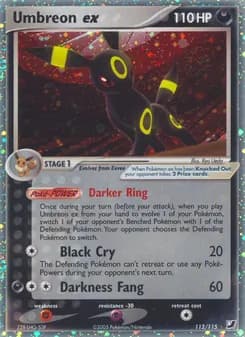
Umbreon ex #112
Rare
A single-star Rare from 2005's Unseen Forces — the older capital-era "ex" cards used the same basic star as any Rare, with value coming from age and demand rather than extra symbols.

Published July 27, 2026 · Updated July 23, 2026 · 11 min read
Pokémon card rarity is printed as a small symbol in the bottom corner of every card: a black circle means Common, a black diamond means Uncommon, and a black star means Rare. Modern sets stack more symbols on top of that star — two black stars for Double Rare, two silver stars for Ultra Rare, and one, two or three gold stars for Illustration Rare, Special Illustration Rare and Hyper Rare respectively.
That is the short answer. The long answer is that the symbols have changed across twenty-plus years of sets, Japanese cards use letter codes instead of extra stars, and two cards of the same Pokémon from the same set can differ in price by a factor of 300 purely because of rarity. This guide walks through every symbol era by era, shows real cards from each tier with their current market snapshots, and ends with a routine for identifying any card's rarity in about ten seconds.
Since Base Set in 1999, the bottom of every Pokémon card carries one of three basic symbols, and they still anchor the whole system today. If you learn nothing else from this guide, learn these three.
Circle — Common. The workhorse cards of every set: basic Pokémon, early evolution stages, simple Trainers. You will pull several per pack, and most are worth only a few cents. They matter for set completion and for playing the game, not for value.
Diamond — Uncommon. Slightly scarcer: middle evolution stages, stronger Trainers, useful Energy variants. Still cheap in almost all cases, still several per pack.
Star — Rare. The classic "good pull". In vintage sets one Rare appeared per pack, either as a plain (non-holo) rare or as a holo rare with a shiny foil picture. In modern Scarlet & Violet and Mega era sets, the single-star Rare is always holofoil. Everything more valuable than this — ex cards, full arts, alternate arts, gold cards — is built on top of the star, either by adding more stars or by changing their color. That is why the first thing an experienced trader does with an unknown card is glance at the bottom corner and count.
The current rarity system arrived with Scarlet & Violet in 2023 and continues through the Mega Evolution era sets like Pitch Black. It replaced the confusing patchwork of earlier eras with a clean ladder of star symbols. From most to least common above the basic Rare:
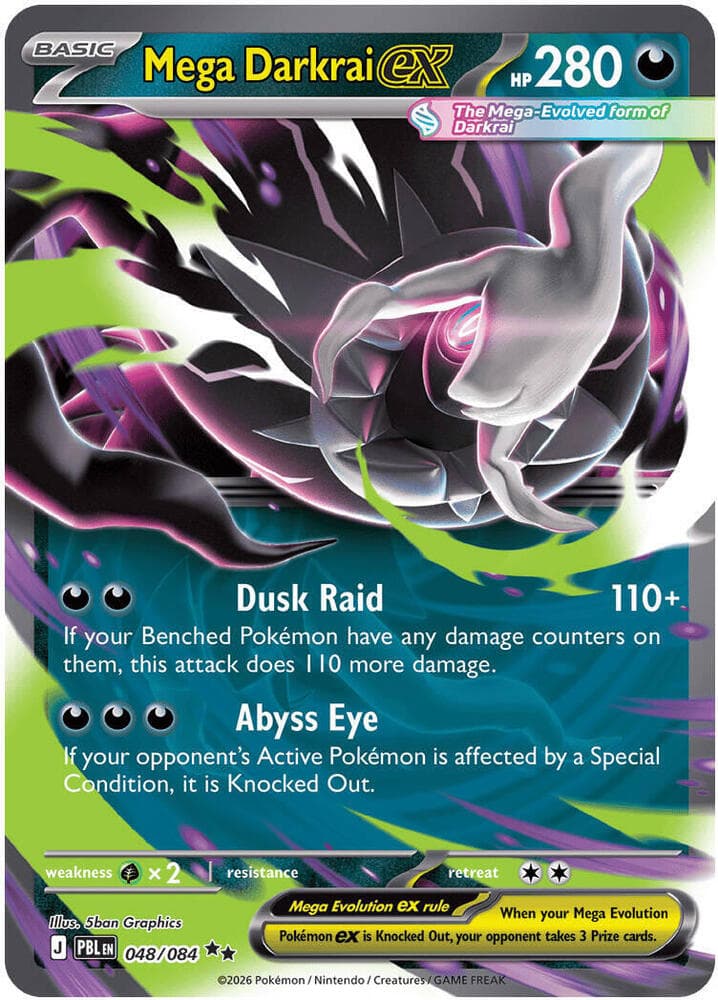
Double Rare — two black stars. These are the standard "ex" cards: playable, foil, pulled fairly often. They look impressive but are usually cheap because supply is high. Mega Darkrai ex #048 from Pitch Black is a Double Rare sitting around $0.92 — a strong card in the game, near the floor of the market.
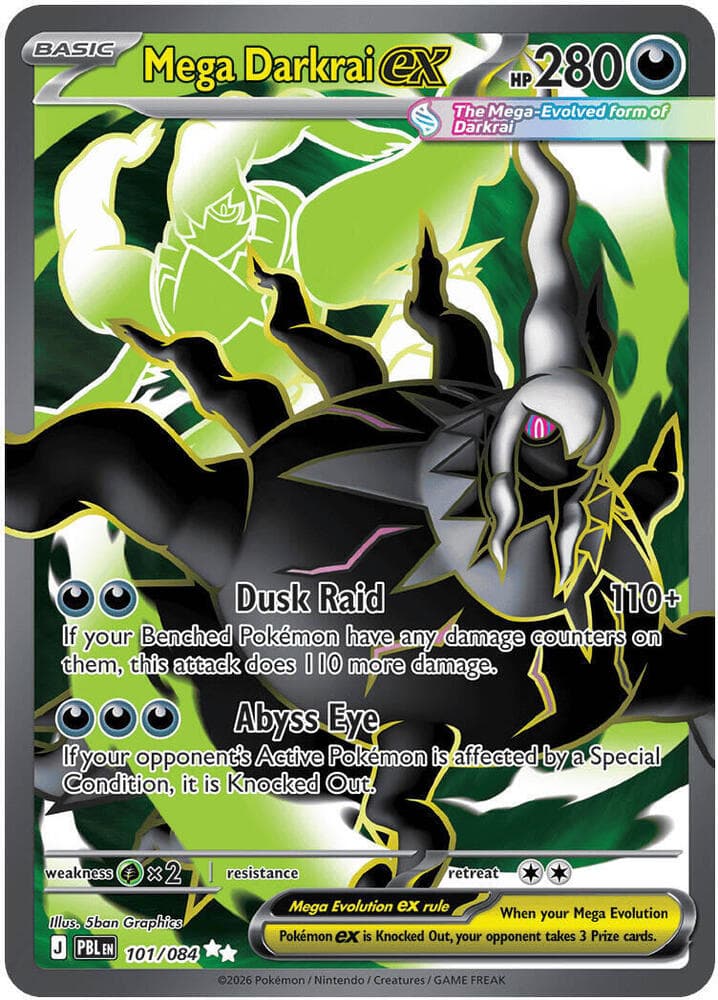
Ultra Rare — two silver stars. Full-art versions of ex Pokémon and Supporters, with the artwork extending across the whole card and a textured foil surface. Scarcer and noticeably pricier: the full-art Mega Darkrai ex #101 from the same set carries a market snapshot around $13.76.
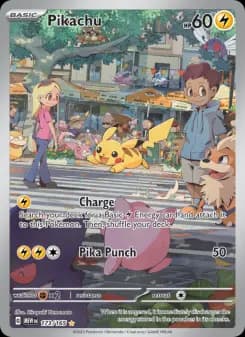
Illustration Rare — one gold star. The fan-favorite tier: alternate artwork, often scenic or story-driven, showing the Pokémon in its world rather than in a battle pose. The Pikachu #173 from the 151 set is a classic example. Illustration Rares are where art taste starts to drive price more than playability does.
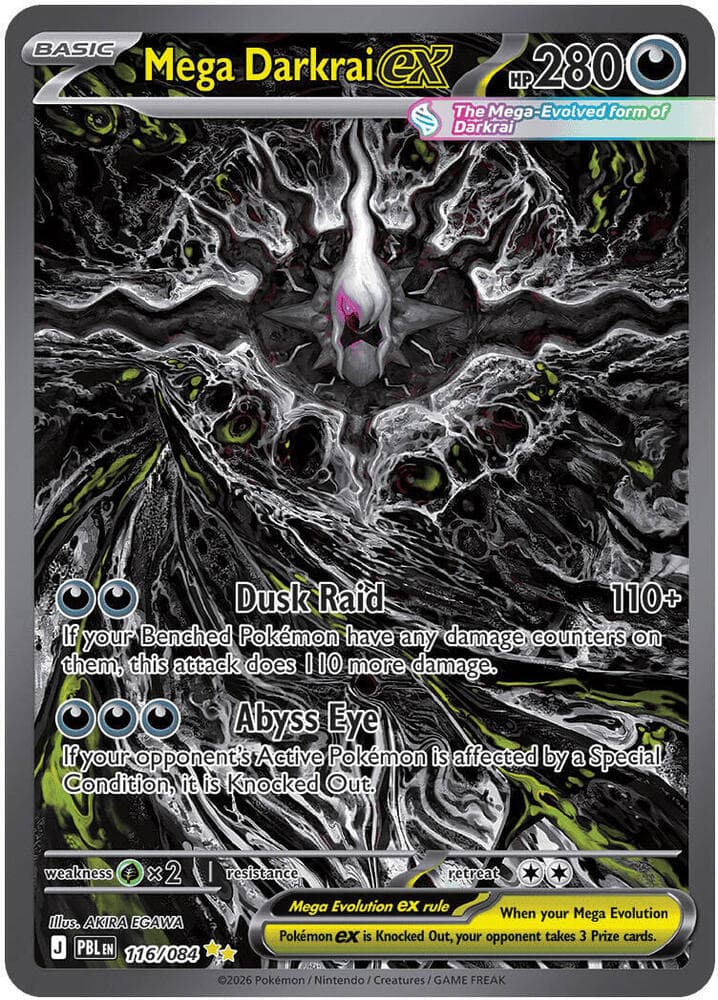
Special Illustration Rare — two gold stars. The chase tier of most modern sets: extended alternate art on an ex or Supporter card, heavily textured, pulled rarely. Mega Darkrai ex #116 is the Special Illustration Rare of Pitch Black and snapshots around $293.88 — over 300 times the Double Rare of the exact same Pokémon in the exact same set.
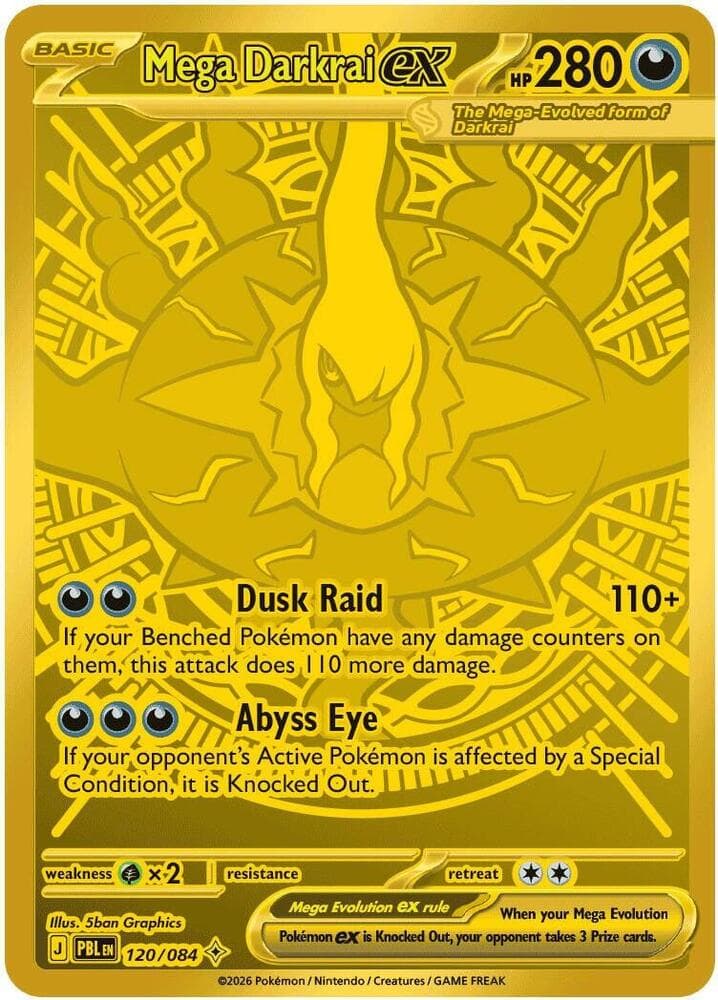
Hyper Rare — three gold stars. Gold-colored cards, numbered above the set total. In the Mega era this slot appears in the catalog as Mega Hyper Rare: the gold-etched Mega Darkrai ex #120 snapshots around $199.60. Note something important: the Hyper Rare is *not* automatically the most expensive card in a set — here the two-gold-star Special Illustration Rare beats it, which is typical of how modern collectors value artwork over gold borders.
Cards from before 2023 use different markings, and you will meet them constantly in binders and trade folders. In the Sword & Shield era (2020–2022), the premium cards were V, VMAX and VSTAR Pokémon, all marked as Ultra Rare with white-star symbols. The most valuable cards of that era are the alternate arts — full-scene artwork versions of V cards — plus rainbow-colored "secret" versions and gold cards numbered above the set total. The era's chase cards, like alternate-art VMAX Pokémon, are among the most traded modern cards anywhere.
In the Sun & Moon era (2017–2019), the equivalent premium mechanic was GX cards, with full-art and rainbow rare versions at the top. Before that, XY had EX cards (capital letters, unlike the modern lowercase "ex"), BREAK evolutions and Mega EX cards. The pattern to remember: each era has a signature mechanic, and its full-art and secret versions occupy the same market role that Illustration Rares and SIRs occupy today.
Two vintage-era markings still cause the most confusion. A holo rare has a shiny foil *picture* with a normal border; a reverse holo is the opposite — the whole card is foil *except* the picture, and any Common, Uncommon or Rare can exist as a reverse holo (one per pack since 2002). Reverse holos are parallel versions, not a higher rarity. Meanwhile, a 1st Edition stamp — a small "Edition 1" badge on the left side of cards from 1999 to the early 2000s — is not a rarity symbol at all but a print-run marking, and it can multiply a vintage card's value many times over. The single-star Rare Umbreon ex from 2005's Unseen Forces in our examples below shows what the older "ex" era looked like: capital star, no extra symbols, value driven by age and demand rather than symbol count.
If you are trading vintage cards, condition matters even more than rarity — a played copy and a mint copy of the same holo can differ in price more than two rarity tiers do. Our card condition guide covers the NM/LP/MP/HP scale in detail.
Japanese Pokémon cards do not add extra star symbols — they print letter codes in the bottom corner instead, and once you know the mapping, Japanese binders become easy to read. The base rarities are C (Common), U (Uncommon) and R (Rare), which map exactly to circle, diamond and star.
Above that: RR ("Double Rare") marks the standard ex cards, equivalent to the two black stars. AR ("Art Rare") corresponds to the English Illustration Rare — one gold star. SR ("Super Rare") covers full-art cards, roughly the English Ultra Rare. SAR ("Special Art Rare") is the direct equivalent of the Special Illustration Rare, and it is usually the chase card of a Japanese set exactly as the SIR is in English. At the top, UR ("Ultra Rare") marks the gold cards that English sets call Hyper Rare — and in the Mega era the top Japanese code appears as MUR for the gold Mega cards, matching the English Mega Hyper Rare slot.
Two practical notes for traders. First, the letter codes make Japanese cards *easier* to identify than English ones — no counting star colors, just read the code. Second, the English and Japanese versions of the same artwork are separate markets: print runs, pull rates and demand differ, so never assume the price of one from the price of the other. When you list or search for a Japanese card, always specify the language of the print — the market treats them as different items.
Rarity is the single biggest price lever inside a set, and the Pitch Black snapshot in this article shows it cleanly because the same Pokémon exists at four tiers. Mega Darkrai ex: Double Rare #048 at $0.92, Ultra Rare #101 at $13.76, Mega Hyper Rare #120 at $199.60, and Special Illustration Rare #116 at $293.88. Identical Pokémon, identical game text, four price points spanning more than 300x — driven entirely by pull rate and artwork.
The ladder also shows the modern market's most useful quirk: the rarest symbol is not always the priciest card. The three-gold-star-tier gold card sits below the two-gold-star Special Illustration Rare, because collectors chase the alternate artwork harder than they chase gold foil. Popularity of the Pokémon matters just as much — an Illustration Rare of Pikachu, Umbreon or Charizard will typically outprice a Special Illustration Rare of an unpopular Pokémon.
Three honest caveats. Rarity only sets the ceiling within a set; condition decides how much of that ceiling a specific copy reaches. Prices move constantly — the figures here are snapshots from our catalog at the time of writing, not promises. And playability adds a second demand stream: a Double Rare that dominates tournaments can outprice prettier cards for a season. If you are new to all of this, our guide on how to start collecting Pokémon cards covers how these forces fit together when you are building a collection from zero.
With the symbols learned, identification becomes a fixed routine. Run these four checks in order and you will place almost any card correctly.
1. Look at the bottom corner. Circle = Common, diamond = Uncommon, one black star = Rare. If it is a letter code (C, U, R, RR, AR, SR, SAR, UR), the card is Japanese — use the mapping from the previous section.
2. Count the stars and note their color. Two black stars = Double Rare. Two silver stars = Ultra Rare (full art). One gold star = Illustration Rare. Two gold stars = Special Illustration Rare. Three gold stars = Hyper Rare (gold card).
3. Check the collector number against the set size. A card numbered *above* the set total (for example 199/165) is a secret rare of some kind — in modern sets that means Illustration Rare or higher; in older sets, rainbow or gold cards.
4. Check the surface. Foil picture with plain border = holo rare. Foil everywhere *except* the picture = reverse holo, which is a parallel of the base rarity, not a promotion above it. Full-bleed textured artwork = Ultra Rare or an Illustration tier. A "1st Edition" stamp on a vintage card is a print-run marking on top of whatever rarity the symbol shows.
That is the entire system. Symbol, star count and color, number, surface — ten seconds, in that order, and the card is identified.
Every card below comes from our live catalog, with market snapshots where available. Together they cover the ladder from a classic single-star Rare to a modern Mega Hyper Rare — including four prints of the same Pokémon from the same set at four different price points.
Rare
A single-star Rare from 2005's Unseen Forces — the older capital-era "ex" cards used the same basic star as any Rare, with value coming from age and demand rather than extra symbols.
Illustration rare
One gold star: the Illustration Rare tier, here as the beloved scenic Pikachu from the 151 set. Art-driven demand starts at exactly this symbol.
Double Rare · Market price: $0.92
Two black stars: the standard Double Rare ex. Strong in the game, pulled often, snapshotting around $0.92 — the floor of the modern premium ladder.
Ultra Rare · Market price: $13.76
Two silver stars: the full-art Ultra Rare version, around $13.76 — same Pokémon as the Double Rare, one tier and one order of magnitude up.
Special Illustration Rare · Market price: $293.88
Two gold stars: the Special Illustration Rare and the true chase card of Pitch Black at around $293.88 — the tier where artwork outprices even gold cards.
Mega Hyper Rare · Market price: $199.60
The gold Mega Hyper Rare, numbered above the set total, around $199.60 — rarer-looking than the SIR, yet priced below it. Symbols set the tier; collectors set the order.
Reading rarity symbols correctly is what turns trading from guesswork into strategy: you know whether the ex in front of you is a $1 Double Rare or a $290 Special Illustration Rare before anyone quotes a number. On Swaptio you can search the exact print you are missing — language, set and rarity included — or offer your duplicates to collectors who are hunting precisely that tier. Every listing links back to the catalog card, so both sides of a swap are always talking about the same print at the same rarity.
If you want to keep leveling up, browse the rest of our set guides and collecting articles on the blog — including card-by-card breakdowns of the newest sets where all of these rarity tiers show up in the wild.
Usually only slightly. A reverse holo is a parallel of the same card, not a higher rarity, so for Commons and Uncommons the premium is small. Exceptions exist for popular cards, and some modern sets add special patterned reverse variants that collectors chase harder — but as a rule, do not treat "it's shiny around the picture" as a big value jump.
A pack — most famously in certain Japanese sets — in which every single card is a high-tier hit (SR or better) instead of the normal mix of Commons and Uncommons. They are extremely uncommon and are a quirk of Japanese pack collation; standard English booster packs do not follow the same god-pack pattern.
That the card is a secret rare: its collector number is higher than the official set size printed as the denominator. In modern sets, everything numbered above the set total is Illustration Rare or higher; in older eras those slots held rainbow, gold or shiny cards. It is one of the fastest rarity checks that exists.
No. Gold Hyper Rares are among the rarest pulls, but Special Illustration Rares regularly outprice them because collectors prefer the alternate artwork. The Pitch Black data in this article shows it: the Special Illustration Rare Mega Darkrai ex snapshots around $293.88 while the gold Mega Hyper Rare sits around $199.60.
The tiers map almost one to one — RR to Double Rare, AR to Illustration Rare, SR to Ultra Rare, SAR to Special Illustration Rare, UR to Hyper Rare — but Japanese cards mark them with letter codes instead of star symbols, and prices differ between the two markets because print runs and demand differ. Always treat the English and Japanese versions as separate prints when trading.