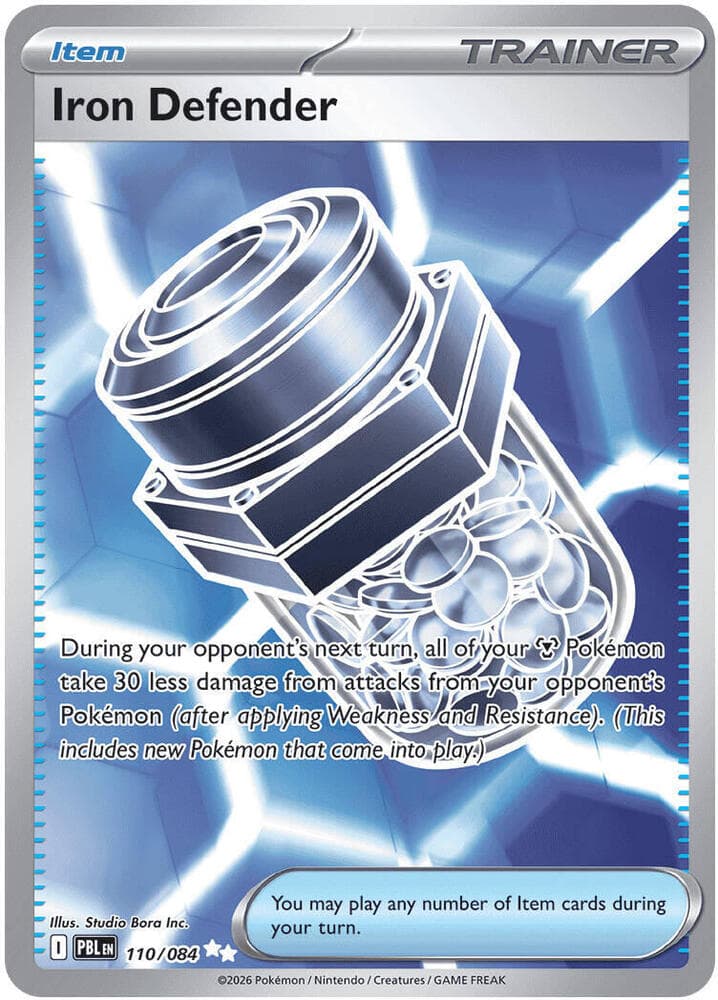
Iron Defender #110
Ultra Rare · Market price: $1.13
Ultra Rare, holo, English print — priced at $1.13 as of August 10, 2026. A textbook example of rarity tier and market price pointing in different directions.

Published August 10, 2026 · 9 min read
Iron Defender is card #110 from Mega Evolution — Pitch Black (set code ME05), printed at Ultra Rare in its holo English version — the same rarity tier that, elsewhere in the same set, sells for hundreds of dollars. If you searched for this card because the price on the listing looked too low to be real, it is real: Iron Defender trades for close to one dollar, and there is nothing wrong with your search results.
That gap between rarity label and market price is exactly what brings people to this page. Some are checking whether a copy sitting in a binder is worth more than it looks. Others pulled it from a booster and are deciding whether it is worth listing, trading away as filler, or sending off to be graded. This guide answers all three: why an Ultra Rare can cost about as much as a common, what actually determines Iron Defender's price, what a reasonable expectation looks like from here, and whether the card deserves a slabbed future or a spot in your trade binder exactly as it is.
Rarity in the Pokémon TCG is a print classification, not a price. It tells you how the card was slotted into the set — how many appear per box, what art treatment it got, where it sits on the pull-rate chart — and nothing about how many people want to own it. Iron Defender checks every box that should, on paper, make it valuable: Ultra Rare tier, holo finish, a scarcer pull than the commons and uncommons around it. What it does not have is the thing that actually moves price in a secondary market: demand that outruns supply.
Demand for a Pokémon card comes from a short list of real drivers — competitive relevance in the current format, the popularity of the Pokémon or the artwork, nostalgia, and how a set's other chase cards pull attention (and money) away from everything ranked below them. Pitch Black's demand is concentrated hard at the top: Mega Darkrai ex's four printings, especially the Special Illustration Rare and gold Hyper Rare, absorb most of what collectors are willing to spend. Everything else in the secret-rare block, Iron Defender included, is priced by what is left over — and what is left over, for a card without a competitive niche or standout art buzz, is close to a dollar.
This is one of the most common surprises in the hobby, and it deserves its own answer, separate from any single card: what actually determines a card's real value is worth reading before you decide what Iron Defender — or anything else in your binder — should really be worth to you.
Pitch Black (ME05, regulation mark PBL) is a 120-card set: 84 numbered main-set cards plus a 36-card secret-rare block that runs from #85 through #120. Iron Defender's number, #110, puts it inside that secret-rare block — the same numbering range that holds Mega Darkrai ex's Special Illustration Rare (#116) and gold Hyper Rare (#120), the two cards responsible for most of the headlines this set got at launch.
Sharing a numbering block with the chase cards is not the same as sharing their demand. The secret-rare range in a modern set typically holds a mix of tiers — Illustration Rares, Ultra Rares, Special Illustration Rares, Hyper Rares — stacked by scarcity and art treatment, and Iron Defender sits at the Ultra Rare rung of that ladder: scarcer than the main-set commons and uncommons, but well short of the illustration-driven cards that collectors specifically chase. For the full rundown of the set — checklist, chase-card hierarchy, product lineup and pull-rate context — see the Pitch Black set guide.
Pitch Black itself is the international release of the Japanese set Abyss Eye, built around the Mega Dimension DLC of Pokémon Legends: Z-A — which is why the set's tone leans darker than recent expansions and why its headline Pokémon are Mega Evolutions rather than the Paradox or Terastal forms of earlier sets. Iron Defender does not carry that spotlight, and that is fine: most of a 120-card set is built from cards like it, filling out the checklist rather than driving the marketing.
We do not have — and will not invent — an exact pull-rate or print-run figure for Iron Defender specifically; that level of precision only exists as early estimates even for the set's headline cards, and it firms up slowly over the weeks after release. What is safe to say is the structural point: Ultra Rares are not a scarce, capped-quantity tier the way a Special Illustration Rare or a gold Hyper Rare is. They pull at a meaningfully higher rate per box, across a print run sized to meet a full international release, which means a large number of copies enter circulation within weeks of street date.
That steady supply matters more than any single number would. A card that keeps arriving in new boxes every day cannot hold a scarcity premium, no matter how the rarity tier is labeled — buyers who want a copy rarely have to compete for one, and sellers who want to move a copy rarely find a shortage on the other side. That is the supply half of the price. The demand half was covered above, and together they explain the dollar-ish price better than any single stat would.
It also helps to think about where a set's supply goes over time. In the first weeks after release, most copies are still moving through retail boxes, prerelease kits and early singles listings — the phase Pitch Black is in right now. Months later, as fewer fresh boxes get opened, supply growth slows down, but so does new demand: by then the collectors chasing the set have mostly already gotten what they wanted. A mid-tier card like Iron Defender rarely benefits much from that later slowdown, because it was never scarce enough for a thinner trickle of new copies to matter — there are already plenty in circulation to meet the demand that exists for it.
As of August 10, 2026, Iron Defender's live market price in the Swaptio catalog is $1.13 for the English holo print (#110, Ultra Rare) — the figure shown at the top of this page and the only price quoted in this guide, pulled straight from current catalog data rather than estimated.
What should you expect from here? Not a prediction — nobody can honestly give you one — but a framework. A card sitting near a dollar has very little room to fall further, and the set is still less than a month past release, which means most of the early supply is still working its way through the market. Cards at this price level tend to move sideways for a long stretch rather than trend sharply either way, because there is no scarcity story left to unwind and no likely competitive breakout to change demand overnight. For the general logic of when a price level is worth acting on and when it is just noise, see when to trade a card and when to hold it.
It is tempting to treat a dollar card as not worth the sleeve it is in. That misses what a card like Iron Defender is actually good for on a peer-to-peer exchange: it is easy to move. A high-value Special Illustration Rare needs a buyer with that much trade value and the patience to negotiate; a $1 Ultra Rare needs almost nothing — it slots into a stack of smaller cards to balance a bigger trade, completes someone's set checklist, or closes a deal that was one card short. Liquidity, not price, is what makes a card useful in a binder.
There is almost always someone building a Pitch Black set who is missing exactly #110, and a card priced this low is an easy yes for both sides of a trade — nobody has to think hard about whether it is a fair deal. That is a real, practical advantage low-value cards have over expensive ones, and it is worth carrying a few Iron Defenders in a trade binder for that reason alone, even without expecting the price to move. For a broader take on what belongs in a binder and what is dead weight, see building the perfect trade binder.
No, in almost every realistic case. Grading a card costs a flat fee per submission, plus shipping in both directions and often insurance, and that all-in cost is many times Iron Defender's $1.13 market price. Even a perfect grade would not close that gap — a graded Ultra Rare from a set without strong card-specific chase demand does not command a meaningful premium over its raw price, so the slab would cost more than the card is worth, before and after grading.
The exception, if there is one, is a bulk group submission where the per-card cost drops close to a few dollars and you are already sending higher-value cards in the same batch — at that point, adding a mint copy of Iron Defender costs little beyond the marginal fee. Outside that scenario, keep it raw, sleeved, and ready to trade; a slab adds cost and turnaround time without adding value at this price point. The full break-even math, company comparison and grading-from-Latin-America logistics are covered in is grading cards worth it.
The live listing behind every price in this guide — check the current market price and open trades for this exact printing.
Ultra Rare · Market price: $1.13
Ultra Rare, holo, English print — priced at $1.13 as of August 10, 2026. A textbook example of rarity tier and market price pointing in different directions.
Whatever Iron Defender is worth to you, the fastest way to find out is to put it in front of the people actually trading it. List what you're looking for if #110 is the piece missing from your Pitch Black set, or offer your copy if you already have one to move — Swaptio prices every printing from real market data, so neither side has to guess what a fair trade looks like. You can also check the live listing for this exact card to see current asks before you commit.
Because rarity tier and market price measure different things. Ultra Rare describes how the card was printed — pull rate, art treatment, numbering — while price reflects demand, and Pitch Black's demand is concentrated in a handful of chase cards like Mega Darkrai ex. Iron Defender is genuinely scarcer than a common, just not scarce in a way enough buyers are competing over.
Almost never on its own. At $1.13, the grading fee plus shipping both ways costs several times the card's value, and even a perfect grade would not close that gap for a card without strong standalone demand. It can make sense as an add-on inside a bulk submission where you are already grading higher-value cards.
Nobody can predict that honestly, but the structural setup argues for a long sideways stretch rather than a sharp move: the price is already near the floor, the set's early supply is still circulating, and there is no competitive-format shift on the horizon that would suddenly spike demand for this specific card.
Playability data isn't published for this specific card in the Swaptio catalog, and price is the more reliable signal here regardless — a $1.13 market price already reflects whatever competitive relevance the card currently has, without needing a separate ruling on it.