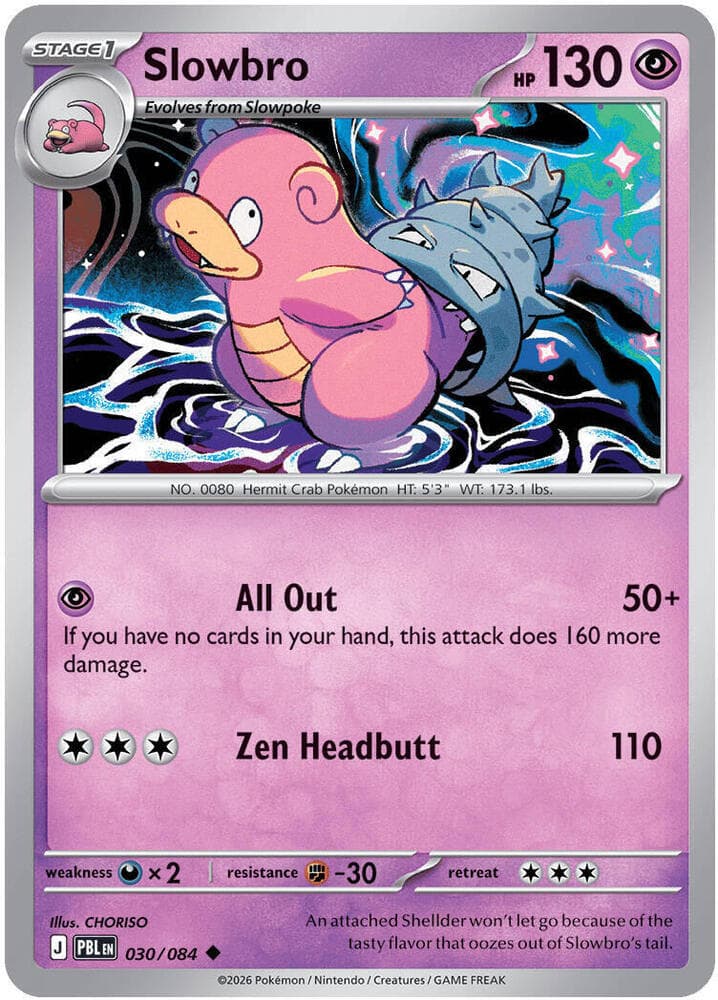
Slowbro #030
Uncommon · Market price: $0.08
Uncommon print from Pitch Black (ME05), priced at $0.08 as of August 10, 2026 — a low-cost, high-nostalgia pickup for any Slowbro or set-completion collection.

Published August 10, 2026 · 11 min read
Slowbro does not need an introduction for most Pokémon fans, but the card in front of you might. Slowbro #030 is an Uncommon print from Mega Evolution — Pitch Black (ME05), the set that brought Mega Darkrai and a cast of Mega Evolutions to shelves in July 2026. It shows one of the first generation's most recognizable Pokémon in a set built around brand-new mechanics, and that combination — an old favorite in a new set — is exactly why collectors keep an eye out for it.
This particular printing will not fund anyone's retirement. At $0.08, it sits at the bottom of the price ladder, next to hundreds of other Commons and Uncommons that fill out every set without ever making a headline. That is not a flaw. It is the reason this card is worth talking about: it is a perfect, low-stakes entry point into set completion, into theme collecting, and into trading itself.
This guide covers what Slowbro means in Pokémon culture at large, what the Uncommon rarity on this specific card tells you, where it sits inside Pitch Black, and why cards exactly like this one are quietly some of the most tradable pieces of cardboard in the hobby.
Slowbro has been part of the Pokémon roster since Red and Blue, the very first generation, and it has held onto a strange kind of fame ever since: it is one of the most affectionately mocked Pokémon in the franchise. The Water/Psychic-type evolves from Slowpoke when a Shellder clamps onto its tail — a detail that has fueled more jokes than almost any other evolution method in the games. Slowbro's entire design language, the drooping posture, the perpetually distracted expression, the slow blink, has made it a shorthand for being spaced out, unbothered, or simply running a few steps behind everyone else.
That reputation is not a knock against the Pokémon; it is exactly why fans love it. Across two and a half decades of games, anime episodes and merchandise, Slowbro has become one of those characters people bring up specifically because it is relatable in its laziness — the Pokémon equivalent of a lovable slacker. It has picked up further forms over the years, including a Galarian variant and an evolution into Slowking, but the original Kanto Slowbro remains the version most players picture first.
None of that changes what a $0.08 Uncommon print is worth on a spreadsheet, but it explains why a card like this one keeps showing up on trade lists years after its set stops being new. People do not collect Slowbro because it is expensive. They collect it because it is Slowbro — a Pokémon that has earned a permanent, fond spot in the collective memory of anyone who grew up with the games.
Every modern Pokémon card carries a small symbol in the bottom corner that tells you exactly how it fits into a set's print run, and Slowbro #030 carries a diamond, which marks it as an Uncommon. On the full rarity ladder, that puts it one step above the humble Common (marked with a circle) and several steps below the Rares, the multi-star Rares, the Illustration Rares, and the gold secret rares that chase collectors talk about. Our full breakdown of Pokémon rarity symbols covers the entire ladder era by era, from the diamond and circle system used today back to the letter codes printed on Japanese cards.
In practice, Uncommon means a card that is scarcer than the basic Pokémon and simple Trainers filling out a set, but still common enough that most collectors will see several copies of it without trying. Slowbro's Pitch Black Uncommon typically depicts a mid-power attack or a useful ability rather than the flashiest artwork in the set — Uncommons are workhorses, not showpieces. They are the cards that make a deck function and a binder feel complete, even if nobody ever stops to admire them the way they admire a Special Illustration Rare.
The practical upshot for collectors is simple: Uncommon rarity tells you almost nothing about how desirable a specific Pokémon is to fans, and everything about how many of that print exist. A beloved Pokémon like Slowbro can be printed as a Common, an Uncommon, a Rare, or a full-art chase card depending on the set — the rarity symbol describes the print run, not the Pokémon's popularity. That distinction matters enormously once you start deciding what is actually worth trading for.
Mega Evolution — Pitch Black (ME05) released worldwide on July 17, 2026, carrying regulation mark PBL and a total of 120 cards — 84 in the main set plus 36 secret rares. It is the international release of the Japanese set Abyss Eye (M5), built around the Mega Dimension DLC of Pokémon Legends: Z-A, and its headline card is Mega Darkrai ex, backed by a supporting cast of Mega Zeraora ex, Mega Chandelure ex and Mega Excadrill ex. Our complete Pitch Black set guide walks through the full 120-card list and the chase cards driving the set's early presale prices.
Slowbro #030 sits well away from that spotlight, and that is normal — every set of this size needs dozens of Uncommons and Commons to round out the print run between its handful of headline chase cards. What makes its presence notable is simply that it is *there at all*: a first-generation Pokémon, designed decades before Mega Evolution existed as a mechanic, appearing in a 2026 set built entirely around a brand-new gameplay concept. Pitch Black leans into a darker, moodier cast than recent Pokémon sets, and a classic, faintly comic character like Slowbro stands out precisely because of the contrast.
For set collectors working through Pitch Black number by number, #030 is one of the easy gets — cheap, plentiful, and not competing with the presale frenzy around the set's gold and Illustration Rare cards. It is exactly the kind of card that is far easier to pick up through a trade than to hunt down pack by pack.
It is easy to assume that only expensive cards get sought after, but that is not how nostalgia-driven collecting actually works. A meaningful share of collectors are not chasing value at all — they are chasing a specific Pokémon, in every set, at every rarity, regardless of what it costs. For a character like Slowbro, that means a Common from one set, an Uncommon from another, and eventually a Rare or full-art from a third all belong on the same want list, purely because they share the same Pokémon.
This is one of the quieter but steadier forms of demand in the hobby. It does not show up as a price spike, and it will not put an Uncommon like Slowbro #030 anywhere near the presale charts that track a set's headline chase cards. But it shows up constantly in trade requests, in wishlists, and in the kind of collection where every single card shares a theme instead of a rarity tier. A classic first-generation Pokémon printed as an Uncommon in a brand-new 2026 set is, in a very real sense, exactly what a nostalgic collector is looking for — not because it is rare, but because it completes something.
That demand rarely translates into a higher market price, and it should not. An Uncommon stays an Uncommon regardless of how many people want a copy of it specifically; supply is simply too large for scarcity pricing to kick in. What it does mean is that a card like this one moves — steadily, quietly, one trade at a time — long after the set itself has stopped being talked about.
As of August 10, 2026, this specific Slowbro #030 print carries a market price of $0.08 — eight cents. That is not a typo, and it is not a card in poor condition dragging the number down; it is simply what an Uncommon in a recent, well-printed set costs once the presale window closes and supply catches up with demand. Prices like this exist for the overwhelming majority of cards in any set, even the most hyped ones — they just rarely get written about, because there is no dramatic story in a card that costs less than a stick of gum.
That is exactly the point worth making. Collecting Pokémon cards has a reputation, fueled by headline-grabbing gold cards and four-figure Illustration Rares, for being an expensive hobby. Slowbro #030 is the quiet counter-example: a real card, from a real, current-release set, featuring a genuinely beloved Pokémon, available for less than a dime. Building a themed collection, filling out a binder, or simply owning a piece of a set you like does not require chasing the cards that make headlines.
For a card at this price point, the economics of trading beat the economics of buying almost every time. A single trade — swapping a duplicate you already have for a copy of Slowbro #030 — costs nothing beyond the shipping or meetup logistics, and skips the friction of a cash transaction for an amount barely worth processing. It is the clearest possible illustration of why Swaptio exists: plenty of the cards people genuinely want are not expensive, they are just scattered across other people's collections instead of yours.
If Slowbro is your Pokémon — the one you have been fond of since childhood, or the one that just makes you smile every time it shows up — the most efficient way to collect every printing of it is not to buy booster boxes and hope. It is to build a want list across every set Slowbro has appeared in and trade specifically for those cards, one at a time, from collectors who already have duplicates sitting in a box.
Opening packs for a specific card is a lottery with terrible odds; Uncommons and Commons show up reliably, but you cannot choose which Pokémon lands in your hand, and most packs simply will not contain the one you are after. Trading sidesteps the randomness entirely. On Swaptio, you can list exactly what you are looking for on **/busca** — Slowbro #030 included — and connect directly with someone holding a spare copy, instead of paying full retail for a booster box on the chance that one specific Uncommon shows up inside it.
It works in both directions, too. If you already have Slowbro cards sitting in a binder that you are not actively using, listing them on **/ofrece** puts them in front of exactly the kind of nostalgic, theme-driven collector this guide has been describing — the trade equivalent of finding a card's rightful home instead of letting it gather dust.
This approach becomes especially interesting once you start looking across eras. Vintage cards from the Wizards of the Coast years (1999–2003) command real premiums for age, scarcity and nostalgia in a way modern Uncommons simply do not, and it is worth checking whether an older Slowbro print exists in the wider card catalog if that vintage look is part of what you are chasing — our vintage versus modern Pokémon cards guide explains exactly what separates those two markets and what to expect from each. A modern $0.08 Uncommon and a decades-old vintage print of the same Pokémon are different collecting goals entirely, and there is nothing wrong with pursuing both at once.
The current Swaptio catalog listing for this specific Pitch Black print, with its live market price.
Uncommon · Market price: $0.08
Uncommon print from Pitch Black (ME05), priced at $0.08 as of August 10, 2026 — a low-cost, high-nostalgia pickup for any Slowbro or set-completion collection.
Swaptio is built around trading, not buying — the goal is to connect people who already have what someone else is looking for, without either side needing to spend much beyond the trade itself. Slowbro #030 is a low-friction example of exactly that: cheap enough that almost nobody minds parting with a spare copy, and specific enough that a themed collector will genuinely want one.
If Slowbro is on your want list, head to **/busca** and add it — it takes a minute, and it puts you in front of anyone offering a copy. If you already have a duplicate sitting around, list it on **/ofrece** so it can find its way to someone actually building a collection around it, instead of sitting unused in a box.
No. It is an Uncommon — marked with the diamond symbol — which is common enough that most collectors will come across multiple copies without trying. Its value comes from being a beloved, recognizable Pokémon, not from scarcity.
As of August 10, 2026, this print carries a market price of $0.08. That is typical for an Uncommon in a current set once presale demand settles.
Mega Evolution — Pitch Black (ME05), released worldwide on July 17, 2026. It is the international release of the Japanese set Abyss Eye (M5). See the full Pitch Black set guide for the complete 120-card list.
Plenty of collectors are chasing a specific Pokémon across every set and rarity it has appeared in, not just the expensive chase cards. For Slowbro fans, an Uncommon like this one completes a theme collection regardless of its market price.
Trading beats buying at this price point. List it on **/busca** on Swaptio and connect with a collector who already has a spare copy to offer.