Toucannon Illustration Rare (Pitch Black #094): Complete Guide
Published August 10, 2026 · 10 min read
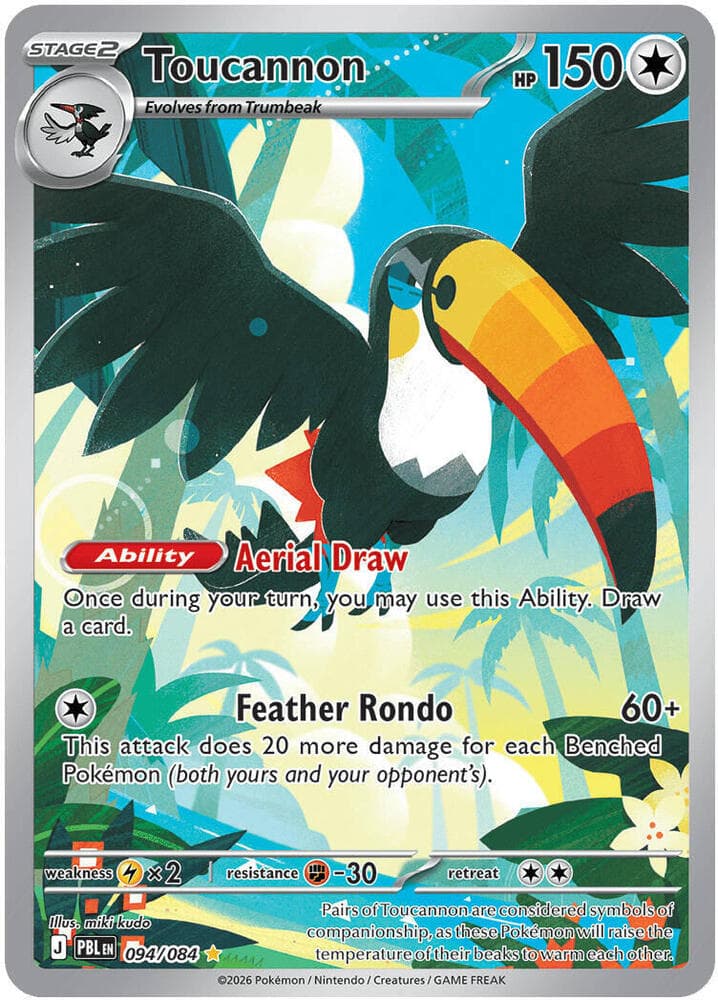
Toucannon #094 is the Illustration Rare printing of Alola's cannon-beaked woodpecker, closing out the three-card Pikipek line in the English-language Pitch Black set (set code me05). It carries the single gold star that marks the Scarlet & Violet era's scenic-art treatment, sits above the set's 84-card main run in the secret-rare block, and — unlike most Illustration Rares built around a set's headline Pokémon — dresses up a card nobody expected to see reprinted with full-bleed artwork.
That gap between expectation and execution is exactly why people keep searching for it: a common bird evolving into a genuinely collectible chase card, at a price that does not require chasing a Special Illustration Rare's budget. This guide covers what an Illustration Rare actually is, why Toucannon earned one, where it sits inside Pitch Black, what it trades for right now, and how to look after the textured surface once you own it.
None of that requires deep expertise to start with: this is a $5.35 card, not a four-figure chase, which makes it a reasonable first Illustration Rare to actually hold in hand rather than only read about.
What an Illustration Rare is, and why a Toucannon has one
The short version lives in our rarity symbols guide: a single gold star means Illustration Rare (IR), the Scarlet & Violet era's scenic-art treatment for regular, non-ex Pokémon. It replaced the Sword & Shield-era Alternate Art concept — a full-bleed illustration built around a scene rather than a battle pose — and turned it into a guaranteed slot in the back pages of every set rather than an occasional surprise on a V or VMAX card.
We go deeper into how IR compares to Full Art, Alternate Art and Special Illustration Rare (SIR) in our special art rarities guide — worth reading first if any of those terms are unfamiliar. The short answer for Toucannon: because the IR slot is reserved for non-ex Pokémon rather than for a set's marquee legendaries, it regularly lands on ordinary evolution-line closers instead of cover stars. Toucannon, the third stage of a three-Pokémon Normal/Flying line with no ex counterpart in Pitch Black, was exactly the kind of card the slot exists for.
The same idea carries over to Japanese print sheets under a different label: what English sets call Illustration Rare, Japanese sets print as AR (Art Rare) — same gold-star tier, same rule about landing on non-ex Pokémon, just a letter code instead of a star count. If you ever cross-reference a Japanese set list against an English one, the AR line and the IR line are the same cards wearing different rarity labels.
The artwork: why Pitch Black's Illustration Rares have a following
Illustration Rares are popular for a reason that has nothing to do with rarity math: they are simply nicer to look at than the card they replace. Since the Scarlet & Violet era standardized the treatment, every IR gives its Pokémon a full-canvas scene — an environment, a moment of action, a mood — instead of the tight, symmetrical battle pose that defines a regular print. Pitch Black continues that visual language across its whole IR run, and the etched foil texture under the ink adds a physical dimension a screen never quite shows.
None of this requires knowing who illustrated a specific card to appreciate it — the appeal is structural, not personal: modern IRs read as small standalone paintings that happen to also be tournament-legal cards. That is also why they anchor so many binder pages and trade lists independently of competitive relevance. Toucannon will never see competitive play; its Illustration Rare exists purely because the format rewards good art with a market of its own.
It also explains why Illustration Rares travel well outside single-card price charts: a completed run of a set's IRs functions as a mini art portfolio in its own right, which is why so many trade threads and want lists are organized by "the IR page" rather than by individual card name. Toucannon's slot in that page is exactly that — one entry in a run collectors track as a set, not just as an isolated pull.
Toucannon's place in the Pitch Black set
Our Pitch Black set guide covers the full 120-card checklist — 84 main-set cards plus 36 secret rares, released as the Mega Evolution era's adaptation of the Mega Dimension DLC from Pokémon Legends: Z-A. Toucannon's regular uncommon print sits at #068, the final link of a plain three-card chain — Pikipek, Trumbeak, Toucannon — that exists mostly to fill out the set's evolution pages. On its own, #068 is unremarkable pack fodder.
The Illustration Rare at #094 is what changes that. It sits inside the secret-rare block above the 84-card main set, the same tier that holds every SIR and Hyper Rare in Pitch Black, and it is the only version of Toucannon anyone actively chases. Landing on a set list already anchored by expensive Mega ex Special Illustration Rares, Toucannon's IR was already on record as one of the more affordable entries in that block at release — the kind of card that lets a collector own a piece of the secret-rare run without committing to the set's headline chase cards.
Numbering above the 84-card total is the fastest tell that a Pitch Black card belongs to the secret-rare block rather than the main set — #094 signals Illustration Rare or higher before you even read the rarity text on the card itself, the same shorthand that applies across the whole Scarlet & Violet and Mega era catalog.
Market price today: an accessible way into art-card collecting
As of today, Toucannon's Illustration Rare (#094) snapshots at $5.35 in the Swaptio catalog. That is a real market figure, not a suggested price — and it puts the card firmly in impulse-trade territory compared to the Special Illustration Rares that headline the same secret-rare block, which regularly trade for many multiples of that figure.
That gap is the point. A $5.35 Illustration Rare buys the same core experience as a much pricier SIR — full-bleed scenic art, textured foil, a card numbered above the set total — at a level where getting one wrong barely stings. For anyone deciding whether modern Illustration Rare collecting is worth the effort, Toucannon is close to the cheapest possible way to find out, and its price makes it a natural piece to throw into a trade to balance out a larger deal rather than something you need to save up for.
Prices for secret rares tend to move the most in the weeks immediately after a set's release, as prerelease hype settles into an actual supply of opened boxes. A snapshot taken today reflects that settled market rather than launch-week speculation, which is part of why it is worth checking a live catalog price instead of relying on a number you may have seen when the set first came out.
Condition and care: reading a textured Illustration Rare
Illustration Rares share a physical trait with every full-art card since 2011: an etched foil layer under the print, plus artwork that bleeds all the way to the edge with no border to absorb minor damage. That combination makes them read differently under a loupe than a regular uncommon like Toucannon's #068 — texture hides small scratches at a glance but reveals them the moment you tilt the card under a light source, and edge whitening shows up faster with no border to mask it.
Our card condition guide walks through the full NM/LP/MP/HP scale with the criteria traders actually use — worth applying literally before offering or accepting a Toucannon IR in a trade. Sleeve it immediately after opening or receiving it, keep it out of direct light for long stretches (etched foil can show wear from repeated flexing more than from age), and check both corners and the bottom edge before you agree that a copy is Near Mint.
For a card you plan to keep rather than flip immediately, a rigid one-touch or magnetic holder protects the etched surface better than a soft sleeve alone — the texture is more vulnerable to compression than a smooth-surfaced card, so anything that lets a binder page or a stack of cards press directly against the foil is worth avoiding on a long-term hold.
Collecting it outright vs. trading for one
At $5.35, buying a single Toucannon IR outright is a reasonable option in a way that a set's flagship SIR usually is not — but trading for one still has an edge for anyone actually building a Pitch Black binder rather than chasing one card in isolation. Completing the Pikipek line, matching an IR to its regular #068 counterpart, or rounding out a page of the set's cheaper secret rares are all goals better served by a trade list than by a string of small individual purchases with separate shipping.
It is also a useful card to have on hand as a trader: low-value Illustration Rares like this one are the kind of piece collectors use to balance a deal, because almost everyone building an Illustration Rare collection is happy to take one off your hands. If you already have a spare Toucannon IR sitting in a binder, it is worth more as trade leverage than as a card gathering dust.
When you do trade for one, apply the same condition standard you would want applied to your own cards: photograph it under consistent light before shipping, describe the grade honestly rather than optimistically, and confirm the specific print — #094, not #068 — before finalizing anything. A mismatched number is the single most common mix-up in low-value secret-rare trades.
Toucannon in the catalog
The Illustration Rare from the Swaptio catalog, with its live market snapshot.
Toucannon's Illustration Rare, snapshotting at $5.35 — one gold star, full-bleed scenic art, and the closing card of an otherwise plain three-stage evolution line. An accessible way into Pitch Black's secret-rare block without the price tag of its Special Illustration Rares.
A $5.35 Illustration Rare is exactly the kind of card that moves through trades faster than it moves through a marketplace listing. Post a want for Toucannon #094 if you are filling out your Pitch Black binder, or list your spare copy if you already pulled one and someone else's want list is where it belongs next.
Either way, the goal is the same one Swaptio is built around: matching what you have with what someone else is looking for, without a marketplace listing fee sitting between a $5.35 card and the person who actually wants it.
Frequently asked questions
What makes Toucannon's Illustration Rare different from its regular print?
The regular Toucannon (#068) is an uncommon with a standard bordered layout. The Illustration Rare (#094) is a separate printing: one gold star, full-bleed scenic artwork, an etched foil texture, and a number placed above the set's 84-card main-set count — the same secret-rare block that holds every SIR and Hyper Rare in Pitch Black. The two share a name and a Pokédex entry, but nothing about how they are printed or valued.
Why does a non-ex Pokémon like Toucannon get an Illustration Rare?
Because the Illustration Rare slot, introduced in the Scarlet & Violet era, is reserved for regular non-ex Pokémon rather than for a set's headline legendaries — that role belongs to Special Illustration Rares. IRs regularly land on ordinary evolution-line closers, and Toucannon, the last stage of a plain Pikipek line, is a textbook example of the pattern.
How much is Toucannon's Illustration Rare worth right now?
As of today it snapshots at $5.35 in the Swaptio catalog — a real market figure, and one of the more accessible Illustration Rares in the Pitch Black secret-rare block. Check the live catalog price before trading, since secret-rare values move as post-release supply settles.
Is Toucannon's IR a good card to start collecting Illustration Rares with?
It is a reasonable one: full-bleed art and textured foil at a price close to a common, so a mistake in grading or trading barely costs anything while you learn what to look for before moving on to pricier SIRs.
Where does Toucannon's Illustration Rare fit in the Pitch Black set?
It closes the Pikipek → Trumbeak → Toucannon line and sits in the secret-rare block above the set's 84-card main list — the same tier as Pitch Black's Special Illustration Rares and Mega Hyper Rares, just at a fraction of the price of the set's headline chase cards.