Lurantis ex (Pitch Black #004): Card Guide, Rarity & Price

Published August 10, 2026 · 10 min read

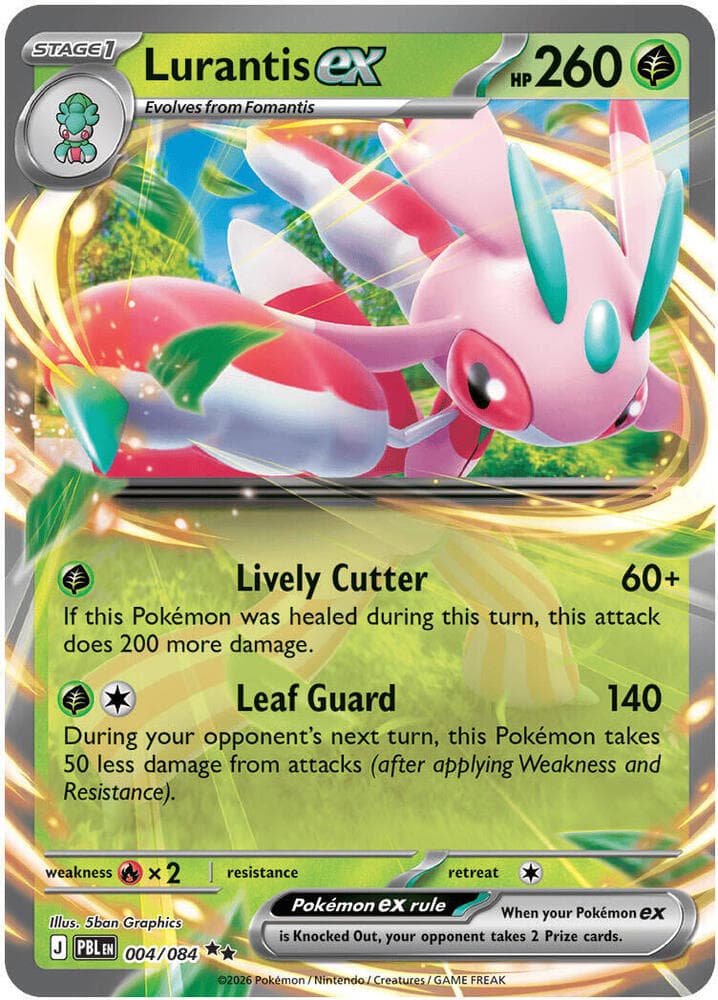
Lurantis ex is the Grass-type Pokémon card numbered #004 in *Mega Evolution — Pitch Black* (set code ME05), printed at Double Rare rarity with a market price around $0.43. Lurantis itself is the Bloom Sickle Pokémon from the Alola region, the final evolution of Fomantis, and in Pitch Black it gets the modern "ex" treatment: a stronger, foil version of the species built for both play and collecting.

People land on this specific card for a few reasons: they pulled it and want to know what they are holding, they are chasing a Grass-type or Alola-region theme, or they noticed the price and wondered why an ex card — usually associated with expensive full-art chase cards — costs less than a coffee. This guide answers all three. We cover what an "ex" card means mechanically, where Double Rare sits on Pitch Black's rarity ladder, where #004 falls inside the set, whether it is worth playing rather than just collecting, and why a $0.43 ex card is exactly the kind of piece a new collector should be building around.

What is an "ex" card in today's Pokémon TCG?

Since the Scarlet & Violet era began in 2023, and continuing through the current Mega Evolution era that Pitch Black belongs to, any Pokémon card whose name ends in "ex" carries the same in-game rule: if your opponent knocks it out, they take two Prize cards instead of one. In exchange for that risk, ex Pokémon are built with more HP and generally a stronger attack or Ability than the ordinary, non-ex printing of the same species. It is a trade-off baked into the card's design, not a rarity label by itself.

It matters to separate "ex" from "Mega" here. Some Pitch Black cards are Mega Evolutions — Mega Darkrai ex, Mega Zeraora ex and similar — which replace a Pokémon's basic evolution line with a Mega Evolution rule when they enter play. Lurantis ex is not one of those. It is a standard ex card: it still evolves the normal way, from Fomantis into Lurantis, and only gains the two-Prize / boosted-stats ex rule on top of that ordinary evolution line. Every Fomantis-Lurantis collector can slot it into the same evolution chain they already know.

One more thing worth knowing before you look at price: "ex" is a card-design category, not a value tier. It shows up across every rarity, from the plain foil Double Rare print up through Ultra Rare full arts and the gold Special Illustration Rare and Hyper Rare treatments of the same Pokémon. The ex suffix on its own tells you almost nothing about what a specific card is worth — the rarity of that specific print does. That is exactly the distinction the next section covers.

Double Rare: where Lurantis ex sits on Pitch Black's rarity ladder

Pitch Black uses the same rarity ladder as every other set in the current era: a black star for the baseline Rare, then Double Rare (two black stars), Ultra Rare (two silver stars), Illustration Rare (one gold star), Special Illustration Rare and finally Hyper Rare at the top. Our rarity symbols guide breaks down every tier with real examples if you want the full picture, but the short version is: Double Rare is the entry point of the "ex" ladder, not its peak.

That position explains the price. Double Rare is the standard foil print of an ex Pokémon — the version that shows up reliably across print runs, without the alternate art or full-bleed illustration that pushes a card into Ultra Rare or Illustration Rare territory and multiplies its price many times over. Lurantis ex #004 at $0.43 fits that pattern exactly: it is a genuine, playable ex card, priced like one of the more common pulls in the set rather than a chase card.

Card numbering is a quick way to sanity-check where a print sits. Pitch Black's first 84 numbers make up the main set — where the ordinary Double Rare and Ultra Rare prints live — while numbers 85 through 120 are the secret rares: the golds and hyper-foil treatments that carry the biggest price tags. #004 falls inside that first block, which is exactly where a standard Double Rare ex belongs.

Lurantis ex's place in the Pitch Black set

*Mega Evolution — Pitch Black* (set code ME05, regulation mark PBL) released worldwide on July 17, 2026, and is the international counterpart of Japan's Abyss Eye (M5). It contains 84 main-set cards plus 36 secret rares — 120 cards in total — built around the Mega Dimension DLC of *Pokémon Legends: Z-A*. Our full Pitch Black set guide covers the complete card list, the Mega Darkrai ex chase hierarchy, and the promos that shipped alongside the set, if you want the bigger picture.

The set's headline cards are its Mega Evolutions — Mega Darkrai ex, Mega Zeraora ex, Mega Chandelure ex and Mega Excadrill ex — which is why the set leans dark and dramatic in its marketing art. Lurantis ex is not part of that headline cast, and that is the point: sets are built with a small number of expensive chase cards surrounded by a much larger group of ordinary, affordable ex Pokémon that fill out the format and the binder pages. Low card numbers like #004 typically sit early in a set's Pokédex-style ordering, alongside the other Grass-type prints, well ahead of the secret-rare block where the big money sits.

Is Lurantis ex actually playable, or just a collector's piece?

It is worth resisting the assumption that a cheap card must be a weak card. Double Rare ex Pokémon are printed to be used, not just displayed: the extra HP and the stronger attack or Ability that comes with the ex rule are real in-game advantages, and plenty of Double Rare ex cards from recent sets — priced in the same range as Lurantis ex — see real time in constructed decks. Price reflects print frequency, not competitive power; a card can be common in booster boxes and still be a solid tool on the table.

Whether Lurantis ex specifically becomes a fixture of a particular Grass-type archetype is something that shakes out over the weeks and months after a set's release, as tournament results and deck lists accumulate. We are not going to guess at exact numbers here rather than confirm them — that is exactly the kind of detail worth checking against the card's official text and current tournament results before you build around it. What the ex rule guarantees, independent of any deck list, is that this is not a throwaway print: it was designed to hold its own in a match, and that alone is a reason to hang onto a copy even if your interest is collecting rather than competing.

There is also a practical reason to keep a Lurantis ex around even before the format settles: Grass-type support cards and Energy tend to have a long shelf life across multiple sets, so a copy sitting in a binder today can become relevant to a deck built months later. Holding a cheap, genuinely useful card costs nothing while you wait to find out.

Why Lurantis ex's $0.43 price makes it a smart starter pickup

As of today, Lurantis ex #004 carries a market price of $0.43 — cheap enough that budget is simply not a reason to skip it. For someone new to the hobby, that matters more than it sounds: you get a genuine ex card, with the real two-Prize rule and modern foil printing, for the price of a handful of commons. It is a much better first purchase than an expensive chase card you have to save up for, because it teaches you the same rarity system and the same evolution-line collecting logic without any real financial risk.

Our beginner's guide to collecting Pokémon cards walks through a realistic starting budget and the first purchases that make the most sense, and a $0.43 ex card fits that plan perfectly: buy a handful, trade for a few more, and you already have the beginning of a themed collection — Grass-types, Alola-region Pokémon, or simply "every affordable ex I can find" — without touching the four-figure end of the market.

It is also a useful benchmark card to keep in mind. Once you know that a legitimate, playable ex from a current set can sell for well under a dollar, it becomes much easier to spot when a listing or a trade offer is asking too much for a similar card, and much easier to recognize a genuinely fair deal when you see one.

Building your first trade binder around cards like Lurantis ex

A card like Lurantis ex is exactly what a good trade binder is built from: cheap enough that giving it up in a trade costs you nothing real, genuine enough (a real ex, a real modern foil) that it is worth something to the person on the other side of the deal. Our guide to building the perfect trade binder covers the golden rule that makes a binder actually work — only put in cards you are genuinely willing to let go — plus how to organize pages so cards move instead of sitting untouched.

A simple way to start: dedicate a page or two to Grass-type and Alola-region ex cards, with Lurantis ex as an early entry, and grow it as you pull or trade for more. Low-cost, genuinely playable ex cards like this one are the easiest to move in a trade, which is exactly what turns a static binder into an active one.

Keep the page organized by set and number rather than by loose theme alone — it makes it far faster to check your binder against someone else's wishlist mid-trade, and it means you always know exactly which printing of Lurantis ex you are offering before a deal is agreed.

Lurantis ex in the catalog

The exact print this guide is about, straight from the Swaptio catalog: Pitch Black #004, Double Rare, with today's market snapshot.

Lurantis ex #004

Double Rare · Market price: $0.43

Lurantis ex, #004 from Pitch Black, Double Rare, sitting around $0.43 — a genuine ex card at a price that makes it an easy first pickup or trade piece rather than a chase card you have to save for. See this print in the catalog.

View in catalog →

Find or trade Lurantis ex on Swaptio

Swaptio is built for exactly this kind of card: common enough to be easy to find, cheap enough that a fair trade takes seconds to work out, and genuine enough to be worth adding to a themed collection. If you are hunting a copy, publish it on your wishlist so collectors who already have it can find you. If you have a duplicate sitting in a box, list it on your offers so it can go toward someone else's Grass-type binder instead of gathering dust.

Either way, real market prices — the same $0.43 snapshot used throughout this guide — are visible on both sides of the deal, so you and your trade partner can agree on a fair exchange without guessing.

Frequently asked questions

Is Lurantis ex #004 the only version of Lurantis ex in Pitch Black?

No. The Swaptio catalog also lists an Ultra Rare full-art print of Lurantis ex (#096) at a noticeably higher price, around $2.53. Same Pokémon and the same ex rule, but a different, scarcer illustration treatment — always check the card number, not just the name, before trading.

What does the "ex" in Lurantis ex mean?

It is a card-design rule used across the current Scarlet & Violet and Mega Evolution eras: any Pokémon card ending in "ex" gives up two Prize cards instead of one if knocked out, and in exchange is built with more HP and a stronger attack or Ability than the ordinary version of the same Pokémon.

Is Lurantis ex a Mega Evolution card?

No. Pitch Black's Mega Evolutions — Mega Darkrai ex, Mega Zeraora ex and similar — replace part of a Pokémon's evolution line with a Mega Evolution rule. Lurantis ex is a standard ex card: it still evolves normally from Fomantis into Lurantis, just with the ex rule added on top.

Why is a Double Rare ex card so cheap compared to other ex cards?

Rarity, not the ex suffix, drives price. Double Rare is the standard foil print and the entry point of the ex ladder, well below Ultra Rare, Illustration Rare and the secret-rare gold treatments in scarcity. A Double Rare ex being priced under a dollar is completely normal — it is the print run size that changed, not the card's in-game strength.

Is a $0.43 card worth trading for, or should I just buy it?

At this price either works, but trading is usually the better habit to build. If you already have duplicates sitting around, offering one for a card like Lurantis ex costs you nothing extra and helps you practice reading fair trades on cheap, low-risk cards before you ever move something expensive.