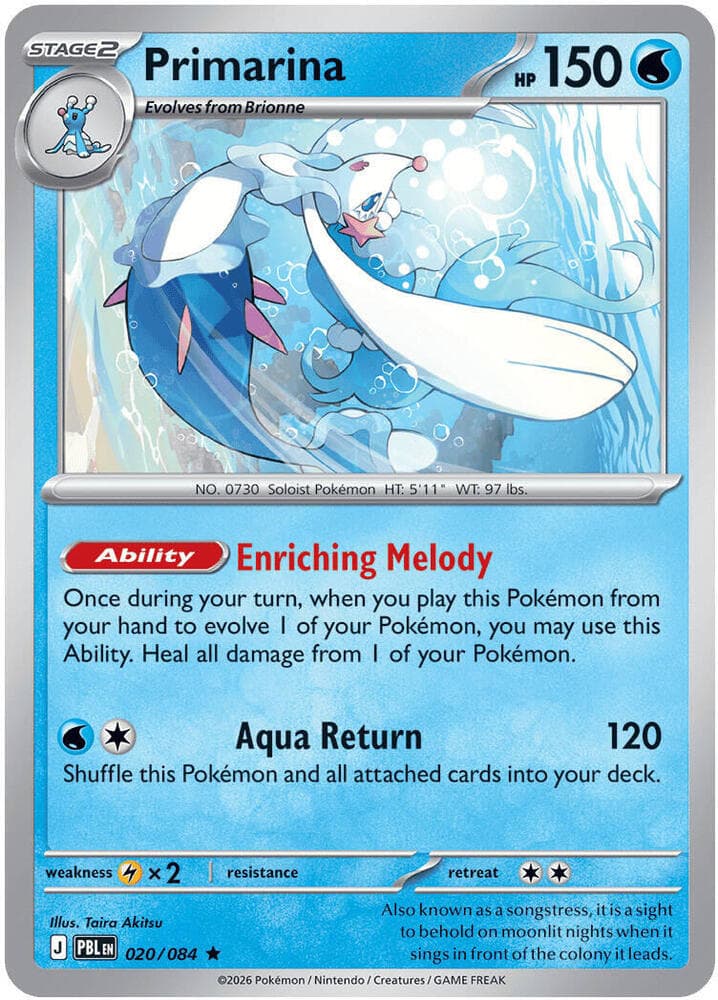
Primarina #020
Rare · Market price: $0.12
The standard Rare print of Primarina from Pitch Black — plain artwork, no special treatment, and a catalog price of $0.12 that reflects exactly that.

Published August 10, 2026 · 9 min read
Primarina is the final evolution of Popplio, one of the three starter Pokémon from the Alola region introduced in Pokémon Sun and Moon. The line runs from a small, clumsy sea lion pup to an elegant, performer-like finisher, and that transformation — plus a Water/Fairy typing that sets it apart from most other starters — has kept Primarina popular with fans well beyond its home generation. On the trading card side, the print this guide is about is Primarina #020 from Pitch Black (set code me05), an English-language card with the basic Rare rarity.
This guide covers four things: who Primarina is as a Pokémon and why people look for it, what the Rare rarity tier actually means, where this specific card sits inside the wider Pitch Black set, and what its real catalog price — $0.12 — says about when trading makes more sense than buying it as a single. Every number here comes straight from Swaptio's own catalog, checked today.
Popplio, Brionne and Primarina make up one of three starter lines from Alola, alongside Rowlet's grass line and Litten's fire line. Popplio starts out as a small, playful sea lion that blows bubbles; by its final stage, Primarina has become a poised, almost theatrical performer, using balloons of water together with its voice as part of its signature style. The line keeps its Water typing all the way through but adds Fairy at the final stage, which makes Primarina one of the relatively small number of official starter Pokémon with a secondary Fairy type — a detail that stands out to anyone who follows typing trivia across generations.
That combination of a graceful design, an unusual typing for a starter, and the general popularity of the Alola generation is why Primarina keeps showing up across merchandise, official art and, of course, the card game. It is not a Pokémon that needs a flashy alternate-art chase print to attract interest — the base design already does a lot of that work, which is part of why even a plain numbered print like #020 has steady, quiet demand from Pokédex-style collectors putting together every stage of the Alola starters, not just competitive players.
There is also a small piece of anime trivia that adds to Primarina's following: in the Pokémon the Series: Sun & Moon animation, the Popplio line belongs to Lana, one of the show's trial captains, rather than to the protagonist. That gives Primarina its own dedicated fan base separate from the usual "main character's starter" crowd, and it is one more reason collectors go out of their way to track down every print of the line — including a plain Rare like #020 — rather than treating it as an afterthought next to flashier Alola cards.
Every modern Pokémon set is built on a rarity ladder, and Rare sits near the bottom of it — one step above Common and Uncommon, and several steps below the alternate-art chase cards that get all the attention on social media. A Rare is marked with a single star symbol printed on the card, the same basic symbol that has marked this tier since the earliest English-language sets. If you want the full breakdown of every symbol in between — Double Rare, Illustration Rare, Special Illustration Rare, Hyper Rare and the rest — our rarity symbols guide walks through the whole ladder with real examples.
What matters for a card like Primarina #020 is simpler: Rare is not a chase tier, and it is not meant to be one. In any given set, the large majority of the card count is Common, Uncommon or plain Rare — the chase rarities that dominate pricing discussions are a small slice by design, both because of how Pitch Black's own structure works and because that is how modern Pokémon sets are built across the board. A Rare like this one is a normal, expected part of a set, not an exception to it.
Pitch Black (set code me05) is part of the current wave of Pokémon TCG releases, and like every modern set it is structured around a handful of expensive chase cards sitting on top of a much larger base of ordinary numbered prints. Primarina #020 is one of those base prints: a plain Rare that fills out the set's card count rather than headlining it. If you want the full picture of what else is in the set, including its chase cards and how the numbering works, our Pitch Black set guide covers the release card by card.
It is worth noting that Primarina also appears elsewhere in Pitch Black at a different rarity, with different artwork and a noticeably higher price — that is normal; a single Pokémon often gets more than one print in the same set, at different points on the rarity ladder. The print this guide focuses on, card #020, is specifically the standard Rare version: straightforward artwork, no special treatment, and a price that reflects exactly that.
It is easy to assume the cards worth talking about are the expensive ones, but for most collectors — especially anyone trying to complete a set rather than chase a single grail — plain Rares like Primarina #020 do more of the actual work. They exist in far greater numbers than the chase prints, which means they are easy to find, easy to trade for, and rarely the bottleneck that stalls a binder for months.
They are also the cards in constant, quiet demand. Someone building their first complete Pitch Black set does not need a Special Illustration Rare on day one — they need every plain Rare and Uncommon filled in first, because those are the numbers that make a binder feel finished. A trade list full of ordinary Rares is genuinely useful to a large share of the collector base, even though no single card on it will ever headline a post. That is not a consolation prize; it is the actual foundation collecting is built on, and it is exactly the kind of card worth having multiples of to trade away.
As of today, Swaptio's catalog snapshot puts Primarina #020 (Pitch Black, Rare) at $0.12. That is a real, current market number, not an estimate — and it is also a useful example of a broader point: at prices this low, the card itself stops being the main cost in the transaction. Packing materials, an envelope, and postage for a single loose card can add up to several times the card's own value, especially once tracking or cross-border shipping gets added on.
This is exactly where trading, rather than buying singles one at a time, starts to make sense. A trade bundles several cards — Primarina plus whatever else is going the same direction — into one shipment, so the fixed cost of packing and postage gets spread across the whole group instead of being paid again and again for individual $0.12 cards. If you are shipping something this inexpensive on its own, it is worth reading our guide to shipping trading cards first: the packing standard does not change with the price, but how you batch and pay for it should.
None of this means a $0.12 card is worthless — it means its real value is what it does inside a complete set, not what it fetches on its own. A collector missing exactly #020 from their Pitch Black binder will happily trade for it even though $0.12 would never justify buying it individually with shipping added on top. The math tilts even further toward trading once geography gets involved: a cross-border shipment that consolidates five or six inexpensive cards into one envelope turns an otherwise uneconomical purchase into a perfectly sensible trade, because the fixed cost of customs paperwork and international postage is the same whether the envelope holds one card or a dozen.
Opening booster packs is a gamble by design — you might pull a chase card, but you are far more likely to end up with duplicates of ordinary Rares like Primarina while still missing others entirely. Trading skips that randomness. If #020 is the specific card missing from your binder, trading for it gets you exactly that card, at a fair price both sides can see, instead of paying pack prices for a random shot at it.
This is also where duplicates earn their keep. Anyone who has opened more than a few Pitch Black packs almost certainly has spare copies of common Rares sitting around; those duplicates are trade currency for filling in the gaps someone else has, and vice versa. Multiplied across a whole set, trading for the specific missing numbers — rather than buying pack after pack hoping to hit them — is usually the faster and cheaper way to actually finish a Pitch Black set. For a broader look at getting started with a Pokémon collection the same way, our beginner's guide to collecting Pokémon cards is a good next stop.
It also helps to think of a set the way a checklist thinks of it: every missing number counts the same toward "complete," whether it is a $0.12 Rare or a headline chase card. Treating the cheap, common numbers as seriously as the expensive ones — instead of leaving them for later — is usually what separates a binder that actually gets finished from one that stalls at ninety percent for years while only the expensive gaps get attention.
The print discussed in this guide, straight from Swaptio's live catalog.
Rare · Market price: $0.12
The standard Rare print of Primarina from Pitch Black — plain artwork, no special treatment, and a catalog price of $0.12 that reflects exactly that.
Swaptio is a collector-to-collector exchange, not a store, which makes it the right place for exactly this kind of card. If Primarina #020 is the number missing from your Pitch Black binder, post it to your want list so collectors holding a spare copy can find you. If you have one sitting in a binder doing nothing, list it to offer — for a $0.12 Rare, a direct trade with someone who actually needs it beats letting it sit unused.
Primarina is the final evolution of Popplio, one of the three starter Pokémon from the Alola region introduced in Pokémon Sun and Moon. Its full line is Popplio → Brionne → Primarina, and it is Water/Fairy type at its final stage.
Rare is a basic rarity tier marked with a single star, sitting just above Common and Uncommon and well below modern chase tiers like Illustration Rare or Special Illustration Rare. Most of the cards in any set, including Pitch Black, are Common, Uncommon or plain Rare — see our rarity symbols guide for the full ladder.
Because it is the standard Rare print, not a chase card — plain Rares are printed in large numbers and are not scarce, which keeps prices low no matter how popular the Pokémon itself is. The same Pokémon has a different, more expensive print elsewhere in Pitch Black at a higher rarity.
Rarely on its own — postage and packing for a single loose card commonly cost more than the card. It usually makes more sense inside a bundle with other cards, or as part of a direct trade where both sides send a group of cards in one shipment. See our shipping guide for how to pack cheap and expensive cards alike.
Trading for the specific numbers you are missing is usually faster and cheaper than buying booster packs hoping to pull them, since packs give you random cards including duplicates of ones like Primarina #020 that you may already have. Post what you're missing and offer your duplicates to trade directly with other collectors.