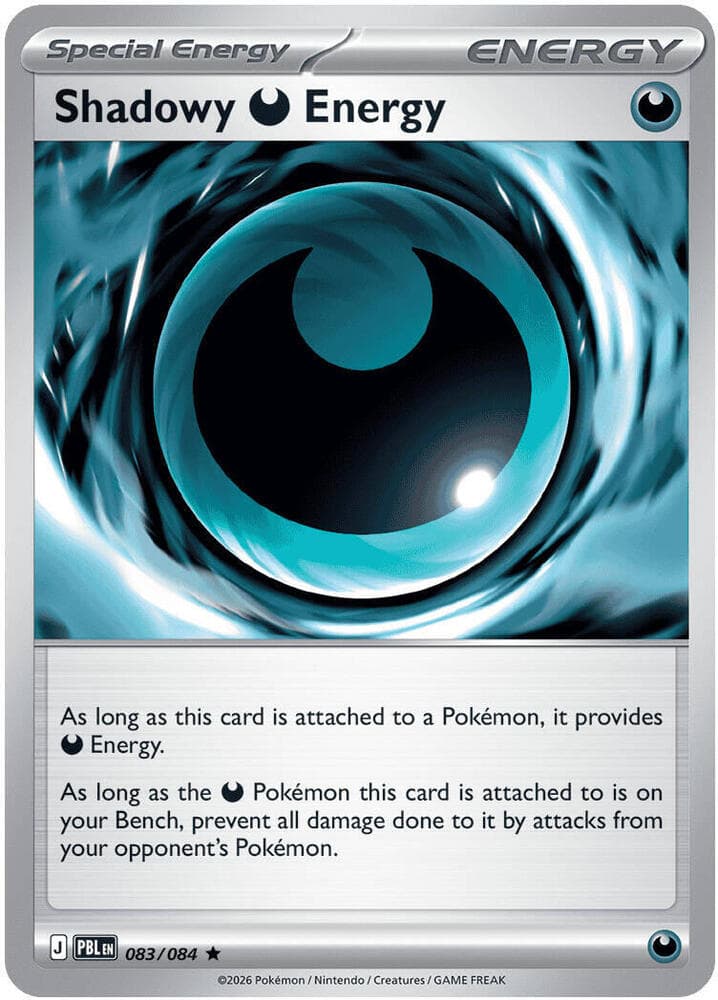
Shadowy Darkness Energy #083
Rare · Market price: $0.14
Card #083, Rare rarity, Pitch Black (me05) — the exact printing behind this guide, priced at $0.14 as of the snapshot above.

Published August 10, 2026 · 11 min read
A special energy card in the Pokémon Trading Card Game is a card from the Energy card type that goes beyond providing the plain, no-rules-text resource that a Basic Energy like Darkness Energy does. Special energies still attach to a Pokémon and still count toward the energy cost of its attacks, but they layer at least one additional rule on top of that baseline function: a restriction, a bonus, or an interaction tied to a specific card family. Shadowy Darkness Energy, card #083 in Pitch Black (me05), is one of these cards — a Darkness-type special energy printed at Rare, the single-star rarity tier, inside a set headlined by a Darkness-type Mega Pokémon.
If you landed on this page, you probably searched the card by name — you pulled it from a booster, saw it in someone's trade binder, or found it listed on a marketplace and wanted to know what it actually is before offering something for it. That is a fair question to ask about any special energy: unlike a Basic Energy, which is functionally identical across every era of the game, a special energy's extra rule is what determines whether it belongs in a competitive deck, a casual binder, or simply a completionist's checklist.
This guide covers what separates basic energies from special ones in general terms, why a card that is not even a Pokémon can carry the same Rare star as a headline creature, where Shadowy Darkness Energy sits inside the Pitch Black set, and — because this is a trading marketplace, not a shop — why energy and Trainer cards like this one are some of the easiest pieces to complete a binder with by trading rather than buying.
None of what follows requires taking a side on whether Shadowy Darkness Energy is "good" — that verdict depends entirely on the exact deck and format it is judged against, which is outside what a marketplace price snapshot can tell you. What this guide can tell you, with confidence: what kind of card this is, how it fits into Pitch Black's checklist, what its real market price is today, and why a card this cheap and this specific tends to move faster by trade than by any other route.
Every Pokémon deck runs on Energy cards, and the ten Basic Energy types — including Darkness Energy — are the simplest version: no rules text box, no conditions, no extra effects. A Basic Energy attached to a Pokémon just provides one energy of its type, and that has been true in every set since the game launched. That consistency is exactly why Basic Energy is printed at Common in effectively every set: the game needs a steady, unlimited-feeling supply of it.
A special energy, by contrast, is printed with its own rules text box, the same way a Trainer card is. That text can do several things: provide more than one energy type at once, restrict which Pokémon it can legally attach to, trigger an effect when it enters or leaves play, or require a specific condition before it can be attached at all. None of that is optional flavor — the rules text is the entire reason a deckbuilder would choose a special energy over the Basic version of the same type.
Because Shadowy Darkness Energy carries a rules text box — a signal of both its card type and its Rare printing — it behaves like a modern special energy: a Darkness-type energy card with an added effect layered on top of the base function of providing Darkness energy, the pattern typical of special energies printed across the Sword & Shield through Mega-era blocks. For the exact wording, check the physical card or the official card database directly; Swaptio's catalog tracks trading data — number, rarity, price, printing — not full rules text.
Special energies are not a recent invention — cards like Rainbow Energy and Double Colorless Energy have existed since some of the game's earliest sets, long before the multi-effect designs common today. What has changed over three decades is complexity: modern special energies increasingly combine a resource function with a secondary effect that shapes how a deck plays, rather than simply offering flexibility in energy type. That trend is part of why an Energy card can carry a Rare symbol today in a way it rarely could in the game's first years.
Rarity in the Pokémon TCG — marked by the circle, diamond and star family covered in our rarity symbols guide — tracks how often a card shows up in a booster pack. It says nothing about whether the card pictures a Pokémon, a Trainer, or an Energy. Any of the three card types can be printed at any rarity a set's designers assign to it.
For special energies specifically, landing on Rare (or higher, for the handful of full-art energies some sets print) usually tracks competitive relevance rather than visual flourish. A special energy earns extra scarcity when its added rule solves a real deckbuilding problem — enabling a strategy, meeting a type requirement, or granting resilience a Basic Energy cannot. Shadowy Darkness Energy carries the single-star Rare symbol used across modern print runs, placing it in the same rarity band as many single-Pokémon rares from the same set, despite having no HP, no attacks, and no way to be Knocked Out.
That is one of the more counterintuitive lessons for anyone new to reading a binder: rarity is a print-run signal, not a judgment about subject matter. A hundred near-identical Pokémon commons can sit next to a single-star special energy that only set completionists and deckbuilders actually go looking for.
This also explains why price and rarity diverge so often for supporting cards. A set's designers assign a rarity tier based on print frequency and card type balance across the whole checklist, decided months before release. The market decides value afterward, based on what decks actually get built and what completionists actually chase — two processes that rarely agree on cards outside the headline Pokémon lineup.
Pitch Black (set code ME05/PBL) is a 120-card set built around Mega Darkrai ex, a Darkness-type Mega Evolution that anchors both the set's cover art and its competitive identity — full background in our Pitch Black set guide. A Darkness-type special energy fits squarely into that theme: sets built around a specific type consistently ship supporting Energy and Trainer cards for that same type, giving a deck built around the set's headliner a dedicated resource to reach for.
Card #083 sits in the back third of the set's 120-card main run — the range where modern Pokémon sets typically place Trainer and Energy support rather than headline Pokémon, which cluster earlier by evolution family, with the ultra-rare and secret-rare chase cards trailing past #120. That ordering is standard for how Scarlet & Violet–era and Mega-era checklists are organized: Pokémon first, then Trainers, then Energy, before the chase tail.
None of this makes Shadowy Darkness Energy a chase card the way Mega Darkrai ex is — its price, covered below, makes that plain. But it does mean any collector chasing a complete Pitch Black master set, not just the expensive alternate-art hits, needs this exact card, and needs it as this exact printing.
Most conversations about Pokémon collecting focus on Pokémon — specifically, the rarest ones. Energy and Trainer cards get treated as filler: the cards you set aside while sorting a binder, not the ones you photograph. That habit means fewer people actively trade for them, and fewer listings exist for any given Energy or Trainer card compared to a popular Pokémon at the same rarity.
That gap is exactly why energies and Trainers deserve attention if your goal is a complete set rather than a highlight reel. A master set — every card in a set's numbered checklist, no exceptions — cannot skip its Energy cards just because they are less exciting to pull. Collectors who only chase Pokémon end up with binders that are 90% finished and permanently stuck on the last handful of Trainers and Energy cards.
This is also where trading has a real edge over buying single cards one at a time. Low-glamour cards like Shadowy Darkness Energy rarely justify a dedicated shopping trip on their own, but they are exactly the kind of card someone else already owns a spare of — from a bulk pull, a duplicate prize card, or a binder they are actively pruning. A direct swap closes that gap faster than waiting for a single listing to show up.
A practical habit worth adopting: sort your binder's Energy and Trainer section by set rather than lumping every Energy card together regardless of printing. Two cards with the same name from different sets are different objects with different numbers and different prices — mixing them makes it harder to see, at a glance, exactly which printings you are missing from a given checklist like Pitch Black's.
As of August 10, 2026, this Rare-printed, Darkness-type energy from Pitch Black trades at $0.14 — well within bulk-card territory despite its star rarity. That is not a data error; it reflects genuine collector and player demand for the card, and it is consistent with how special energies price across the format generally: printed scarcity does not automatically translate into market value the way it does for a chase Pokémon.
The price gap between Shadowy Darkness Energy and Pitch Black's headline pulls — Mega Darkrai ex variants traded in the hundreds of dollars around the set's release — illustrates the point above: rarity measures how often a card is printed, not how much collectors will pay for it. A Rare Energy and a Rare chase Pokémon can share a rarity symbol and sit worlds apart in price.
For a set completionist, that is good news: filling in the Energy and Trainer rows of a Pitch Black checklist costs a fraction of what filling in the Pokémon rows does. The bottleneck is not budget — it is finding someone who has a spare copy of exactly this printing to trade.
Shadowy Darkness Energy sits in a demand pattern that suits direct trading better than almost any other card type in the set. Players building Darkness decks want a playset of it and typically pull or acquire more copies than they need over a season; pure collectors, meanwhile, mostly ignore Energy cards until they need the one they are missing to finish a set. That mismatch — some people holding extras, others needing exactly one — is the textbook setup for a trade.
It also means a card like this rarely sees the price volatility or scalping that affects a set's headline Pokémon. Nobody is buying out the market on a $0.14 Energy card to resell it, so a fair one-for-one or small-bundle trade is easy to agree on without either side worrying about being shortchanged.
That imbalance between who is holding extras and who is missing exactly one copy is precisely the kind of trade a peer-to-peer marketplace is built to solve, without either side needing to price a shop markup into a fifteen-cent card.
None of this requires urgency. A $0.14 card is not going anywhere, and there is no scalper pressure pushing you to act before a price window closes. That makes energy and Trainer trades some of the most low-stakes, easygoing exchanges to arrange — useful if you are new to trading and want practice with the mechanics of a deal before negotiating over a card that actually carries risk.
The exact printing referenced throughout this guide — number, rarity and price pulled directly from the Swaptio catalog snapshot.
Rare · Market price: $0.14
Card #083, Rare rarity, Pitch Black (me05) — the exact printing behind this guide, priced at $0.14 as of the snapshot above.
If Shadowy Darkness Energy is the last card standing between you and a finished Pitch Black checklist, add it to your want-list and let a collector who already has a spare come to you. If you are the one sitting on extra copies — likely, since it prints at bulk rate — list it for trade instead of leaving it in a box nobody sorts through.
Energy and Trainer cards are consistently the most underlisted part of any set on trading platforms, precisely because so few collectors think to look for them. That makes this corner of the hobby one of the more reliable places to close out a binder without competing over a headline chase card. For a broader starting point, see our guides on starting a Pokémon collection and building a trade binder that actually gets you trades.
Any card currently printed and legal for the Standard or Expanded format under Pokémon's rotation rules is tournament-legal, and that includes special energies from recent sets like Pitch Black. Confirm current-format legality against the official rotation list before a tournament, since format legality changes yearly and is not something a marketplace price snapshot tracks.
Rarity measures how often a card was printed in a set, not how much collectors want it. Shadowy Darkness Energy carries the Rare star because of where it sits in Pitch Black's print run, but its market price reflects actual demand — moderate at best, since Energy cards see less collector interest than Pokémon at the same rarity tier.
A Basic Darkness Energy has no rules text — it simply provides one Darkness energy when attached, and is functionally identical in every set it has ever appeared in. Shadowy Darkness Energy is a special energy: it still provides Darkness energy, but its rules text box adds a condition or effect on top of that base function, the way most special energies from recent sets do.
Not for a set completionist. A master set of Pitch Black needs every numbered card, Energy included, regardless of price. The low value actually helps here — it is one of the cheaper cards on the checklist to acquire, whether by trade or otherwise.
Look for listings tied to the Pitch Black (me05) set and card number 083 specifically — Pokémon reprints the same Energy name across multiple sets, and only the me05 printing matches this card's art, number and price data.