Pokémon TCG 30th Anniversary (2026): The Definitive Guide to Every Set, Card, Product and Event

Published August 9, 2026 · 47 min read

Thirty years after *Pocket Monsters Red* and *Green* hit Japanese shelves on February 27, 1996 — and thirty years after the first Pokémon trading cards followed that same October — the Pokémon TCG is throwing the biggest birthday party in its history. The centerpiece is ME: 30th Celebration, a commemorative expansion launching September 16, 2026 as the first *simultaneous worldwide release* the game has ever had. Around it orbits a full year of campaigns: a Super Bowl spot, anniversary promo collections, a World Championships in San Francisco, Japanese starter decks, premium boxes, and a wave of products stretching from September to December 2026.

This guide is the hub for the whole anniversary, built to be the one page you need. It covers the 30 years of TCG history that led here, what the 25th anniversary's *Celebrations* set (2021) teaches us about how these events play out, the 30th Celebration set in full detail — including the new Futuristic Rare rarity and the 30-Pikachu subset — all 19 cards revealed so far commented one by one, the Japanese side of the calendar, every announced product with its official date and price, and a collector's playbook for navigating the hype without getting burned.

A note on rigor, because anniversary hype attracts misinformation: every external fact in this guide — dates, prices, product contents — is sourced, and the source list is published at the end of the article. Where something is *reported but not officially confirmed* (like the full Classic Collection reprint list), we say so explicitly. The 19 revealed cards below come straight from the Swaptio catalog and link to their live pages; none of them has a market price yet, because the set has not been released — so any "price guide" you see elsewhere today is guesswork, and we don't do guesswork.

One calendar clarification before we start, because it trips people up: 2026 is the 30th anniversary of the *Pokémon franchise* (the games launched February 27, 1996). The trading card game itself first went on sale in Japan in October 1996, so the TCG's own 30th birthday lands in October 2026 — right in the middle of the anniversary product wave. Either way you count it, this is the collecting event of 2026. If you already know the history and just want the set breakdown, our ME: 30th Celebration set guide tracks the checklist card by card as it's revealed; this guide is the wider map.

Thirty Years in Five Minutes: How We Got from 1996 to 2026

To understand why the 30th anniversary matters — and why The Pokémon Company is treating it as a global event rather than a product drop — it helps to compress three decades of the card game into one section. The Pokémon TCG began in Japan in October 1996, published by Media Factory, as a companion to the Game Boy games that had launched that February. The first Japanese expansion introduced the template the game still uses today: Pokémon cards with HP and attacks, Energy to power them, and Trainer cards to bend the rules. Among its 102 cards was a fire-breathing rare that would become the single most recognizable trading card of its generation: Charizard.

The English game arrived in January 1999 under Wizards of the Coast, and the timing was perfect: Pokémania was at full boil in the West, and Base Set boosters became schoolyard currency. The Wizards era (1999–2003) gave the game its founding mythology — Base Set, Jungle, Fossil, Team Rocket, the Gym sets with their trainer-owned Pokémon, and the Neo era that introduced Generation 2 along with the first true chase mechanics like Shining Pokémon (Neo Destiny's Shining Celebi among them). The e-Card era that closed the Wizards run (Expedition, Aquapolis, Skyridge) sold modestly at the time but produced some of the most valuable cards of the entire hobby today, including Aquapolis's 'Crystal' Pokémon like Crystal Lugia.

In 2003 The Pokémon Company took publishing in-house worldwide, opening the EX era (2003–2007): Pokémon-ex with bigger stats and bigger risk, Delta Species experiments like Metagross δ, and sets — EX Ruby & Sapphire, EX Team Rocket Returns, EX Unseen Forces, EX Delta Species — whose booster boxes now sit near the top of the sealed-vintage market. The Diamond & Pearl era (2007–2010) brought LV.X cards like Palkia LV.X; HeartGold & SoulSilver (2010–2011) added Pokémon Prime like Gengar Prime and the two-card LEGEND fold-outs like Darkrai & Cresselia LEGEND. Each of these mechanics lasted only an era — which is exactly what makes them nostalgic shorthand now, and exactly why the anniversary set reprints them (more on that below).

The modern game then moved through five well-defined eras. Black & White (2011–2014) revived Pokémon-EX and introduced full-art cards, plus iconic supporters like N. XY (2014–2017) brought Mega Evolution EX cards like Mega Gardevoir-EX and BREAK evolutions like Greninja BREAK. Sun & Moon (2017–2020) introduced GX attacks (Solgaleo-GX) and, in 2019, the two-in-one TAG TEAM cards — including Pikachu & Zekrom-GX, one of only two reprints officially confirmed for the anniversary set so far. Sword & Shield (2020–2023) rode the pandemic-era collecting boom with V, VMAX and VSTAR (Zacian V, Mew VMAX, Arceus VSTAR) and rediscovered alternate-art cards as the hobby's main chase. Scarlet & Violet (2023–2025) then rebuilt the game's look — silver borders, the return of lowercase 'ex', and the Illustration Rare / Special Illustration Rare system that made the art itself the product (our special art rarities guide covers that shift in depth).

Since 2025 the game has been in the Mega Evolution era — the 'ME' prefix you see on current sets — with Mega Evolution ex cards as the competitive spine and paired Japanese/English releases running a few months apart. That's the era the anniversary set belongs to: its full name is ME: 30th Celebration, and its Japanese counterpart carries the MEGA branding. Thirty years of mechanics, ten distinct eras, one continuous game — no other TCG of its scale has run this long under a single brand, and the anniversary set is explicitly designed as a museum tour through all of it. For a broader look at how the old and new game compare as collecting targets, see vintage vs. modern Pokémon cards.

What the 25th Anniversary Taught Us: Celebrations (2021) as Precedent

The best predictor of how a Pokémon anniversary plays out is the last one. For the franchise's 25th birthday, The Pokémon Company released Celebrations on October 8, 2021 — a small commemorative set of 25 all-holofoil cards plus a 25-card Classic Collection: near-faithful reprints of iconic cards from across the game's history, each stamped with the 25th anniversary logo. The reprint list was a nostalgia grand tour — Base Set Charizard, Blastoise and Venusaur, Shining Magikarp, Umbreon Gold Star, Tag Team favorites — printed on modern foil stock with the original artwork intact. Celebrations packs held just four cards and were never sold as standalone booster boxes; they came bundled inside Elite Trainer Boxes, collection boxes and an Ultra-Premium Collection.

What happened next is the part collectors should study. Demand crushed supply for months: Celebrations products sold out at big-box retail repeatedly through late 2021, and sealed product traded well above its retail price on the secondary market — the Elite Trainer Box retailed at $49.99 and became one of the most flipped products of that holiday season. But The Pokémon Company kept printing, and the singles market told a more sober story: because Classic Collection cards fell at high rates (roughly one in three packs, a rate fan press like PokéWallet uses as the baseline expectation for 2026), raw copies of even the Charizard reprint remained affordable and plentiful — a tiny fraction of what a 1999 original costs. The premium concentrated in two places: graded gem-mint copies (a PSA 10 Celebrations Classic Collection Charizard sold for $545 as recently as March 16, 2026, per PSA's auction records) and sealed product held long-term.

The lessons, compressed: (1) Anniversary sets are printed to be opened. The Pokémon Company's stated goal both times has been availability, so scarcity plays that work on a normal set (betting on short print windows) work far less well here. (2) The chase concentrates at the top. Most Celebrations singles settled at pocket-change prices; the value went to the handful of top-end cards, top grades, and sealed boxes. (3) Nostalgia reprints do not dent the originals. Base Set Charizard's market did not fall because Celebrations reprinted it — if anything, the reprint became an advertisement for the original, a pattern our vintage vs. modern guide explores. (4) The frenzy window is short. The hardest weeks to buy Celebrations at retail were the first six; by spring 2022 most products were findable again. Every strategy section later in this guide builds on these four observations.

There's one structural difference in 2026 worth flagging now: 30th Celebration is getting standalone booster availability and a much deeper product line than Celebrations had, plus a simultaneous global launch instead of the staggered, shortage-plagued 2021 rollout. Same playbook, bigger print, better logistics — which, if the 2021 pattern holds, should mean singles are even more accessible and the premium concentrates even harder at the very top of the rarity pyramid.

The Anniversary Year So Far: A Timeline of the 30th Campaign

The Pokémon Company has run the 30th as a year-long, franchise-wide campaign rather than a single TCG event, and the card game is its finale. The Western anniversary logo first surfaced on November 13, 2025, alongside the announcement of a Pokémon Day 2026 TCG collection; Japan's logo debuted in a New Year's teaser on January 1, 2026. The campaign then kicked off loudly in February 2026 with Pokémon's first Super Bowl LX television spot, announced by The Pokémon Company as the opening of a 'yearlong campaign' of anniversary activity.

Pokémon Day — February 27, 2026 — was the hinge. A special Pokémon Presents broadcast marked exactly 30 years since Red and Green launched in Japan, and the day itself was stacked: the first LEGO Pokémon sets went on sale, Pokémon FireRed and LeafGreen arrived on Nintendo Switch with their event tickets pre-loaded, and across the app ecosystem Pokémon GO, UNITE, Masters EX and TCG Pocket all ran anniversary events (TCG Pocket's '30 Days of Gifts' stretched from February 27 to June 27). On the physical TCG side, the Pokémon Day 2026 Collection — released January 30, 2026 with a specially stamped foil Pikachu promo, a metallic 30th-logo coin and three booster packs — was the first anniversary-branded card product on shelves.

Through spring and summer, the TCG campaign continued with the First Partner Illustration Collections: three promo series released March 20, June 19 and August 7, 2026, featuring illustration rare–style promo cards of the first partner (starter) Pokémon from all nine generations — a deliberate echo of the oversized First Partner Pack promos from the 25th anniversary. The Pokémon Company International has also been running family-friendly 'Day Out' and adult-oriented 'Night Out' anniversary events across 2026, and Asia got large-scale celebrations of its own, including Korea's month-long Pokémon Mega Festa in May.

The competitive calendar peaks in the anniversary year too: the 2026 Pokémon World Championships run August 28–30, 2026 in San Francisco — with finals staged at the Chase Center and, for the first time, a public-facing PokémonXP fan convention running alongside the tournament. Then comes the main event for collectors: the ME: 30th Celebration expansion on September 16, 2026, followed by anniversary product waves on October 2, October 30, November 6 and December 4 (the full product-by-product calendar, with official prices, is later in this guide). If you're planning a collecting budget for the rest of 2026, those five dates are the skeleton of it.

ME: 30th Celebration in Detail: 128 Cards, All Foil, One Global Date

Now the centerpiece. ME: 30th Celebration (Japanese: MEGA Expansion Pack 30th CELEBRATION) launches September 16, 2026, and the release itself makes history before a single pack is opened: it is the first Pokémon TCG expansion ever released worldwide on the same day, in every language the game prints — including, notably, Simplified Chinese. For a game that has spent 30 years releasing in Japan first and everywhere else months later (a gap we dissect in our Japanese vs. English cards guide), a synchronized global street date is a genuine first and a statement of intent.

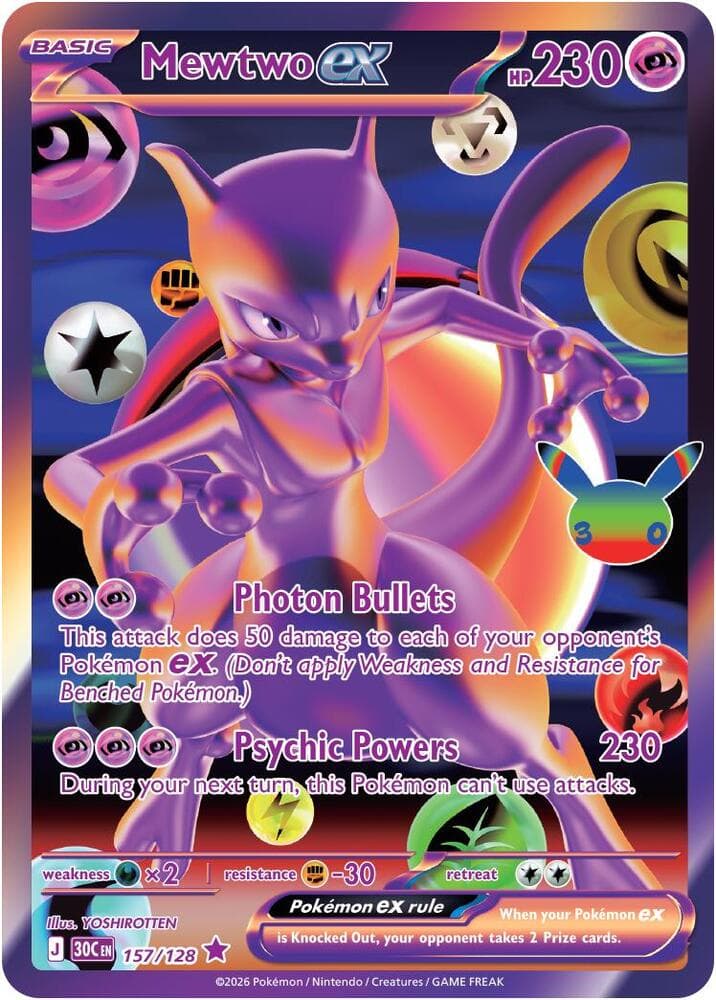
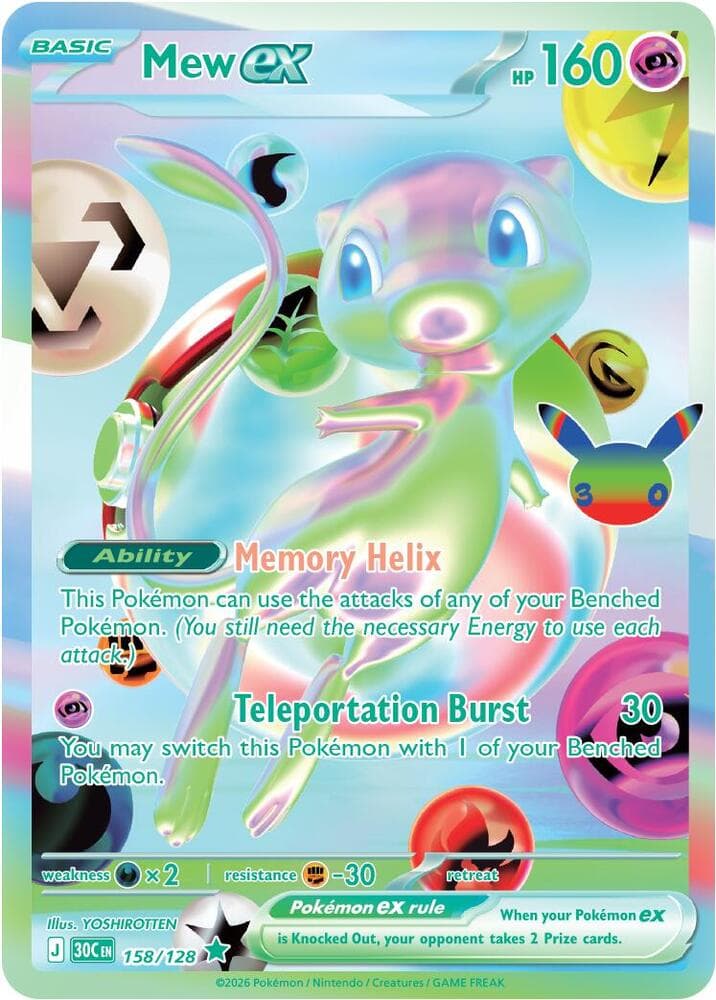
The numbers: the set checklist runs to 128 printed cards, with secret rares numbered above that — the revealed Futuristic Rare Mewtwo ex and Mew ex sit at #157 and #158, telling us there are roughly 30 secret-numbered cards, and Bulbapedia currently counts the English set at 160+ cards all-in. Two production decisions define the product's feel. First, every single card in the set is holofoil — commons, Trainers, even basic Energy — and every card carries the Pokémon 30th Anniversary logo. Second, every booster pack is guaranteed to contain one of 30 different Pikachu cards, each drawn by a different illustrator with its own foil pattern. There is no such thing as a 'dead pack' in this set by design.

The set's content is organized around three pillars. Pillar one: the celebration checklist — new cards for fan-favorite Pokémon across all nine generations, with a heavy Eevee theme: the revealed cards already include Eevee, Espeon, Umbreon and an Eeveelution ex line (Espeon ex, Umbreon ex, Sylveon ex revealed so far, joined by Greninja ex and, per the official set page, Jirachi ex). Many of the set's Illustration Rares are built around a day-and-night motif — Espeon for day, Umbreon for night — that also structures the premium products (the Ultra-Premium Collection literally ships in 'Day' and 'Night' variants). Pillar two: the 30 Pikachu subset, the pack-by-pack thread. Pillar three: the Classic Collection, 30 reprinted cards from 30 years of the game, each with a special '30' Pikachu-silhouette foil stamp. Each pillar gets its own section below.

Japanese product configuration, for those buying JP: packs contain 6 cards at ¥360, with 20-pack booster boxes at ¥7,200 — notably smaller boxes than a standard Japanese set, at a premium per-card price befitting an all-foil product. Japan also gets exclusive premium packaging, including a 30th Celebration 'Futuristic Box' at ¥27,500 and Espeon & Umbreon premium deck sets at ¥6,200 (per PokéGuardian's coverage of the June 1, 2026 reveal). English-side product configurations and prices are covered in the products section. One thing that does *not* exist yet, anywhere, is market pricing: as of this writing (August 9, 2026) no 30th Celebration card has sold on the open market, which is why every card in this guide shows no price. When the set releases, live prices will appear on each card's Swaptio page automatically — that's the moment to start watching, and our set guide will track the checklist as it fills in.

The New Rarities: Futuristic Rare and the 30 Pikachu

Every anniversary set needs a hook that has never existed before, and 30th Celebration has two. The first is Futuristic Rare (FUR in Japanese rarity shorthand) — a brand-new rarity tier debuting in this set with exactly two revealed cards: Mewtwo ex (#157) and Mew ex (#158). Both are illustrated by YOSHIROTTEN, a Japanese graphic artist and art director brought in from outside the game's regular illustrator pool, and the cards look like nothing the TCG has printed before: vibrant, poster-like, digital-first compositions that read more like club-flyer art than trading-card art. The choice of subjects is deliberate — Mewtwo and Mew anchored the original 1996–1999 era and its first movie — but the treatment points forward, which is the whole thesis of the rarity's name: 30 years back, 30 years ahead.

Where Futuristic Rares sit in the pull structure is not yet officially published — they are secret-numbered (above #128), which historically means the rarest tier of a set, and preorder attention has treated them as the set's twin crown jewels since the June 1, 2026 reveal. If you want to understand how a new rarity tier slots into the existing hierarchy of Illustration Rares, Special Illustration Rares and hyper rares, our rarity symbols guide and special art rarities breakdown map the current system; Futuristic Rare adds a new top-adjacent branch to that tree rather than replacing anything.

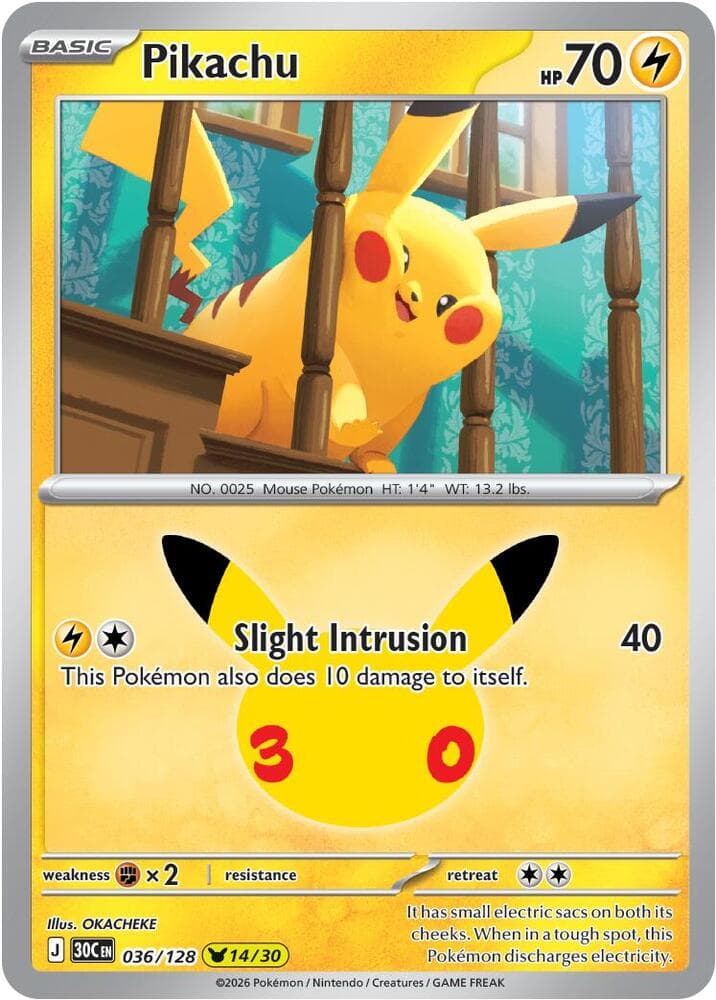
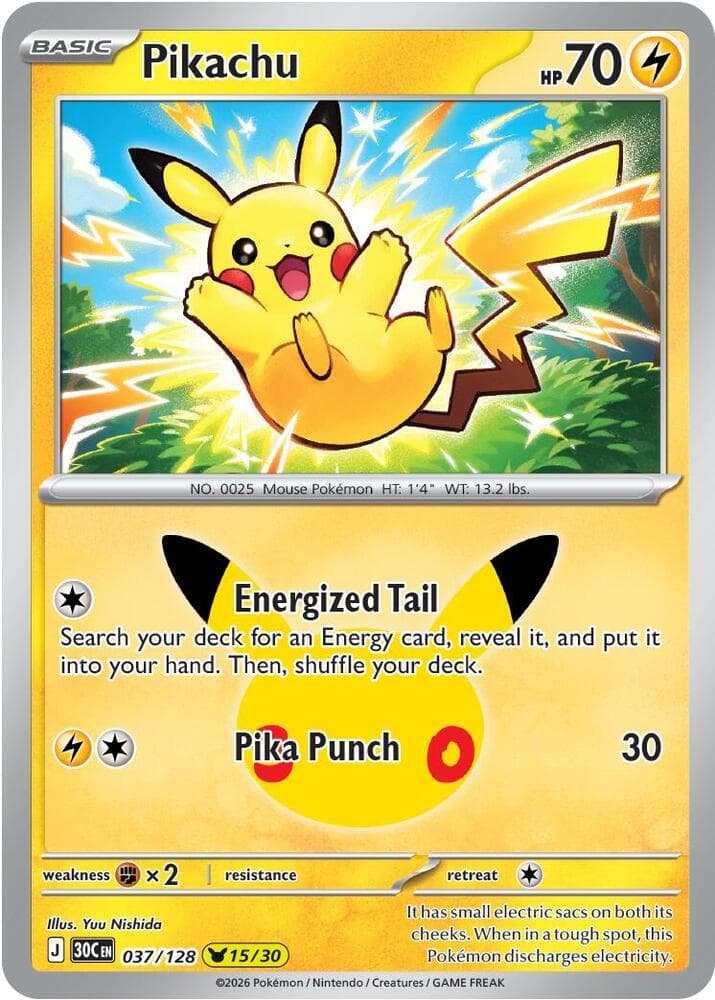
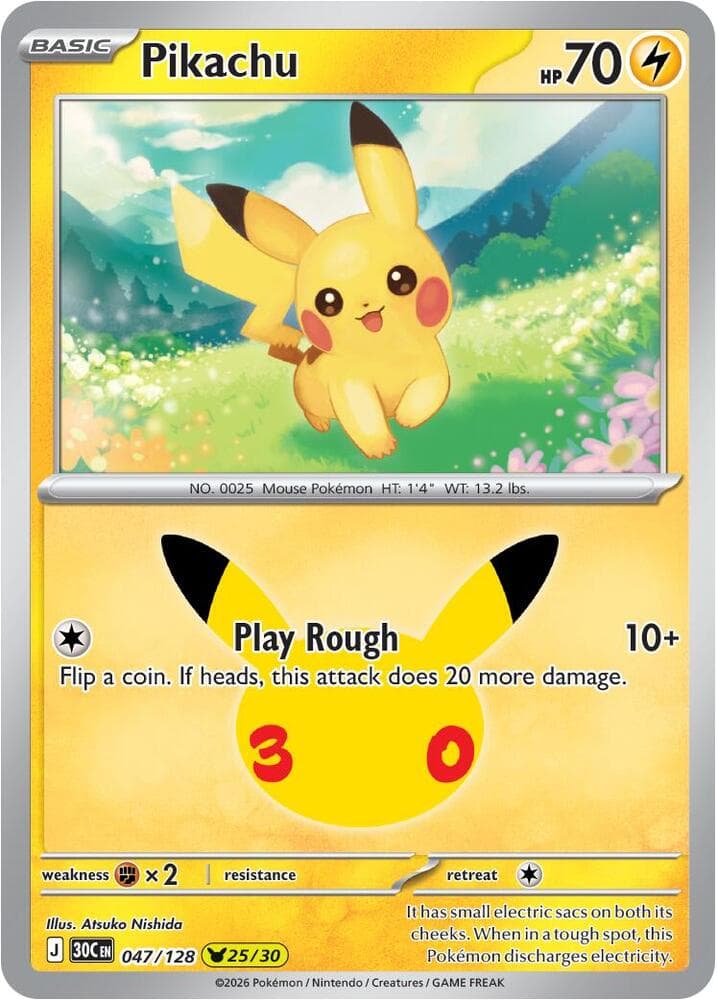
The second hook is the 30 Pikachu subset — and structurally it's the more radical of the two. Thirty different Pikachu cards, each by a different illustrator, each with its own holofoil pattern, and one guaranteed in every booster pack. Three of them are already in our catalog (#036, #037 and #047, commented in the card-by-card section below). This is pack design as celebration: whatever else your pack contains, it contains a unique piece of Pikachu art. It also creates a self-contained collecting project with a clear finish line — 'the Pikachu binder' — that we expect to become the set's defining community activity, the way the 25-card Classic Collection was for Celebrations in 2021.

A practical note for set collectors: a guaranteed 1-per-pack subset of 30 cards means Pikachu singles will be *abundant* in absolute terms, but completing all 30 from packs alone still takes real volume (coupon-collector math is unkind: even with perfectly even distribution, expect to open well over 100 packs to see all 30). The efficient route to a complete Pikachu binder will be trading your duplicates for the ones you're missing — exactly the kind of many-for-many swap a peer-to-peer exchange handles better than buying each single at retail markup. Duplicate Pikachu will be the set's natural trade currency; plan accordingly.

A word of caution specific to a rarity nobody has handled yet: brand-new rarities are exactly what counterfeiters target first, because buyers have no reference point for what the real card should feel or look like. Once Mewtwo ex and Mew ex start circulating after September 16, expect a wave of proxies and 'custom' versions sold as real, especially in listings targeting collectors who only know the rarity from photos. The usual authenticity checks — card stock weight, print line sharpness under light, the texture of the holofoil pattern against a known-genuine card from the same era — all still apply to a Futuristic Rare; our guide to spotting fake Pokémon cards walks through the physical tests in detail, and it's worth rereading in September specifically because this rarity has zero collector muscle memory built up yet. When in doubt, buy from sellers with a real trading history rather than a brand-new account with a single 'rare find.'

The Classic Collection: 30 Reprints from 30 Years

The emotional core of the set — and, if 2021 is any guide, its long-term identity — is the Classic Collection: 30 classic cards from across the game's entire history, reprinted with their original artwork, a special holofoil treatment, and a '30' Pikachu-silhouette foil stamp in the corner of the artwork. The Pokémon Company has officially confirmed two cards so far: Base Set Charizard, the 1999 icon, reprinted with textured holofoil; and Pikachu & Zekrom-GX from 2019's Team Up, the TAG TEAM era's poster card. Both were showcased in the set's reveal on June 1, 2026.

The other 28 have not been individually announced — but they have very likely been *seen*. In June 2026, the Japanese 30th Celebration website flashed a montage that fan press (PokéWallet, PokéBeach and others) frame-captured and identified as the complete reprint lineup. Treat this list as reported, not confirmed — but it is specific and internally consistent, and it reads like a decade-by-decade museum tour: from the Wizards era, Base Set Pikachu and Charizard, Gym-era trainers Misty and Erika's Jigglypuff, Neo Genesis Sneasel, Neo Destiny's Shining Celebi and Aquapolis's Crystal Lugia; from the EX era, Delcatty (EX Ruby & Sapphire), Dark Tyranitar (Team Rocket Returns), Scizor ex (Unseen Forces) and Metagross δ (Delta Species); from DP through HGSS, Palkia LV.X, Uxie (Legends Awakened), Crobat G, Gengar Prime and both halves of Darkrai & Cresselia LEGEND; from BW through XY, N, Rayquaza-EX, Genesect-EX, Mega Gardevoir-EX and Greninja BREAK; and from the modern game, Solgaleo-GX, Buzzwole-GX, Pikachu & Zekrom-GX, Zacian V, Vivid Voltage's chunky Raikou, Mew VMAX, Arceus VSTAR and Paldea Evolved's Illustration Rare Magikarp.

Read that list twice and the curation logic pops out. It is not a 'greatest hits by price' list — there's no Base Set Blastoise, no Umbreon Gold Star, no Moonbreon. Instead it picks one emblem per mechanic: one LV.X, one Prime, one LEGEND (both halves), one δ Species, one BREAK, one TAG TEAM, one VSTAR. Competitive history gets its due alongside collector history — Uxie, Crobat G and N are legendary tournament staples that casual collectors might not recognize, and their inclusion signals the list was built by people who remember what actually got played at tables, not just what grades well. It also deliberately avoids re-running 2021's Celebrations list: of the reported 30, only Base Set Charizard and Pikachu repeat.

Two open questions matter for collectors. First, pull rates: The Pokémon Company has not published how Classic Collection cards are seeded in 2026. In Celebrations they fell roughly one-in-three packs; 30th Celebration's Ultra-Premium Collection is confirmed to contain a dedicated Classic Collection booster pack, which suggests the reprints may be distributed both in regular packs and in their own pack type. Until official rates or early box breaks land, don't pay 'guaranteed hit' prices based on assumptions. Second, legality and versions: like the 2021 reprints, these are commemorative — the fan-press consensus is they're collectibles first, and several (LEGEND halves, LV.X) belong to mechanics that no longer exist in the modern game. None of this diminishes the draw: for anyone whose first binder had a Gengar Prime or a Crystal Lugia in it, this subset is the anniversary.

The Japanese Side: Storm Emeralda, MEGA Starter Decks and the JP Calendar

The anniversary looks slightly different from Japan, and if you buy Japanese cards — or trade with people who do — the JP calendar is worth understanding on its own terms. The headline difference is that for the anniversary set itself, there is no difference: MEGA Expansion Pack 30th CELEBRATION launches in Japan on the same September 16, 2026 date as everywhere else. That synchronization is historic. For every other set in the Mega Evolution era, Japan runs months ahead — and the set filling Japanese shelves this summer proves the point.

That set is M6: Storm Emeralda, released July 31, 2026: 76 base cards plus 37 secret rares (113 total), sold in ¥6,000 booster boxes of thirty 5-card packs. It's the sixth Japanese Mega Evolution expansion, headlined by Mega Rayquaza ex — which appears in both Special Art Rare and top-end Master Ultra Rare treatments — alongside Mega Golisopod ex, Mega Golurk ex, Mega Malamar ex, a Special Art Rare Raikou ex, the Trainer card Zinnia's Trust in SAR form, and the series' first split Legendary Stadium mechanic. Its English counterpart, ME06: Delta Reign, arrives November 6, 2026 in the standard Western configuration of 10-card packs and 36-pack boxes. So an English-market collector's autumn actually contains two majors: the anniversary set in September and Delta Reign in November — with Japanese collectors having had the latter's contents since July. Our dedicated Storm Emeralda / M6 set guide covers that set card by card.

July 31 was a double release day in Japan: alongside Storm Emeralda came three MEGA Starter Set ex theme decks at ¥1,800 each — 60-card ready-to-play decks built around brand-new Eevee ex, Zoroark ex and Meowscarada ex cards, each deck including exclusive new cards and an Illustration Rare of its headliner. As of this writing, no English release has been announced for these decks — they are Japanese-only, which historically makes their exclusive cards disproportionately interesting to Western collectors (Japanese-exclusive Eevee products have a strong track record of becoming import favorites, and an Eevee ex starter deck landing six weeks before an Eeveelution-heavy anniversary set is clearly not a coincidence — it's the same celebration seen from Tokyo). All three decks are already indexed in the Swaptio catalog, so you can search for their cards or list yours to trade.

Why does the JP/EN split matter for an anniversary guide? Three reasons. Price discovery: Japanese sets reveal a set's contents and establish early relative values months before English release — Storm Emeralda singles trading in August tell you a lot about what Delta Reign chase cards will be in November. Arbitrage of attention: hype concentrates on English launch windows, while Japanese copies of equivalent cards often trade quieter and cheaper. Print and quality differences: Japanese cards differ in stock, centering tendencies and language premium dynamics — the full picture is in our Japanese vs. English guide. For 30th Celebration specifically, the simultaneous launch removes the timing gap but not the product differences: Japan's smaller 20-pack boxes, its exclusive Futuristic Box packaging, and its own promo circuit mean JP and EN anniversary collections will still look meaningfully different side by side.

Every Anniversary Product Announced, with Official Dates and Prices

The Pokémon Company International revealed the full English product line at the end of June 2026, and it is the deepest anniversary lineup the TCG has ever had — five release waves from September to December. All prices below are official MSRPs compiled from the press lineup, distributor listings and Pokémon Center (sources at the end of the guide); street prices during the hype window will differ, which is its own topic later. Wave one lands with the set on September 16, 2026. The Elite Trainer Box ($49.99) packs nine boosters, an illustration rare–style Nidorina promo — a pleasingly deep cut for a flagship promo slot — 65 sleeves, 16 foil basic Energy and the usual accessories; the Pokémon Center exclusive ETB upgrades to eleven packs and a second, logo-stamped Nidorina. The Pokémon ex Box ($21.99) comes in Sylveon ex or Greninja ex variants with the promo in both full size and oversize. The Poster Collection ($14.99) includes three packs, promo cards of Articuno, Zapdos and Moltres, and a double-sided poster of the full set. The Tech Sticker Collection ($14.99) offers an Alolan Exeggutor or Lucario foil promo with matching sticker sheets; the Knock Out Collection and 2-Pack Blister ($9.99 each) carry two packs and a foil Eevee promo with a commemorative coin.

Wave two, October 2, 2026, is the accessible wave: the Booster Bundle ($26.94, per Pokémon Center's listing) with six packs; the Binder Collection ($31.99), a 9-pocket binder plus five packs — an obvious home for the 30-Pikachu project; Mini Tins ($9.99) in ten designs, each with two packs, a sticker sheet and an art card, the ten tins assembling into two complete panoramic images; and the quarterly Mini Portfolio ($5.49), a 60-card portfolio with one booster whose Q4 artwork features Mega Greninja, Mega Zeraora, Mega Darkrai and Mega Chandelure. Wave three, October 30, is for players: Battle Decks ($19.99) in Espeon ex and Umbreon ex versions — ready-to-play 60-card decks, notably all-foil, with deck box, coin, playmat and exclusive illustration rare promos.

Wave four, November 6, 2026, is the premium wave, sharing the date with Delta Reign's launch. The Ditto Premium Collection ($39.99) displays a Ditto promo in a colorful acrylic case, with eight packs. The Figure Collections ($29.99) come in Mew or Mewtwo variants with a sculpted figure, foil promo, oversize card and five packs. And the flagship: the Ultra-Premium Collection ($179.99), in Day (Espeon) and Night (Umbreon) variants — each with 29 booster packs plus one dedicated Classic Collection booster pack, foil promos of Pikachu ex and Espeon ex or Umbreon ex, a playmat, sleeves, deck box, metal coin and dice. At 30 total packs it's the single deepest anniversary product, and its Classic Collection pack is currently the only *guaranteed* route to reprints that has been officially described. Wave five closes the year on December 4 with Sylveon ex and Greninja ex tins ($21.99). For completeness: a 10-count ETB case carries a $499.90 MSRP for those buying at case level.

Japan's premium lineup differs: besides standard 20-pack booster boxes at ¥7,200, PokéGuardian's reveal coverage lists the 30th Celebration Futuristic Box at ¥27,500 and Espeon & Umbreon Premium Deck Sets at ¥6,200. A blunt buying note that follows from the 2021 precedent rather than from speculation: every product above is a fixed bundle of packs plus a promo and accessories, so its 'value' is mostly determined by what packs are worth after launch — and in 2021, patient buyers who waited out the first six weeks bought nearly everything at or below MSRP. Nothing announced so far is numbered, limited-run or print-capped except by ordinary allocation. The only products with a structurally unique component are the Ultra-Premium Collections (the Classic Collection pack) and the Pokémon Center ETB (the exclusive stamped promo) — which is exactly where 2021's premiums ended up concentrating.

A note on *where* to buy, since it matters as much as what to buy during a launch window like this one. Big-box retail (Target, Walmart) restocks unpredictably and sells out within minutes when it does, which is precisely the environment that produces the scalper markups this guide keeps warning about. Local game stores typically allocate a fixed number of units per product and let known customers reserve ahead of street date — a slower process, but one that skips the resale premium entirely and keeps the money in a shop that will still be there for Delta Reign in November. The Pokémon Center's own exclusives (the upgraded ETB among them) sell directly and cap per-order quantities specifically to blunt bot and reseller purchasing. None of these channels guarantee MSRP pricing in the first weeks, but all three beat paying a stranger double for something that will be back on shelves by October.

Promos, Events and Campaigns: The Anniversary Beyond the Packs

A striking amount of the 30th anniversary's card output lives *outside* booster packs, and promo collectors should map it early because promos are where anniversary scarcity actually happens (packs get reprinted; event promos usually don't). The confirmed promo circuit so far: the Pokémon Day 2026 Collection's stamped Pikachu (January 30); the three First Partner Illustration Collections (March 20, June 19, August 7) with illustration rare–style promos of all nine generations' starters; and the product-attached promos listed above — Nidorina (ETB), the Legendary bird trio (Poster Collection), Alolan Exeggutor and Lucario (Tech Sticker), Eevee (Knock Out/blister), Sylveon ex and Greninja ex (ex Boxes and December tins), Espeon ex, Umbreon ex and Pikachu ex (Battle Decks and Ultra-Premium Collections), and Ditto (Premium Collection).

On the event side, the anniversary's physical peak is the 2026 Pokémon World Championships in San Francisco, August 28–30, with Championship Sunday at the Chase Center and the first-ever PokémonXP fan festival running alongside — a significant format change that turns Worlds from a competitor-focused event into a public celebration in the anniversary year. Worlds historically brings exclusive stamped promo cards and merchandise, and anniversary-year Worlds promos have a strong collecting pedigree. Through the rest of 2026, The Pokémon Company International continues its 'Day Out' (family) and 'Night Out' (adult) event series announced as part of the anniversary campaign.

Two things have not been announced, despite persistent rumor-mill claims, and this guide will say so plainly. First, there is no announced 30th-anniversary equivalent of 2021's Golden Box or a numbered/serialized premium item; if a mega-premium Japanese collector box exists beyond the ¥27,500 Futuristic Box, it hasn't been revealed as of August 9, 2026. Second, there is no announced modern reprint of vintage sealed product (no 'Base Set box re-release') — the Classic Collection reprints inside 30th Celebration are the entirety of the officially known vintage-revival program. Treat any listing or video claiming otherwise as unverified. This guide will be updated as new announcements land through Worlds and the fall waves; the anniversary campaign has consistently dropped news at franchise beats (Pokémon Day, Worlds, set launches), and more reveals between now and December are likely — but 'likely' is not 'announced', and we won't pretend otherwise.

A strategy note specific to promos: because each anniversary promo is tied to one product at one price point, its long-term scarcity is set by that product's sales, not by pull rates — which historically makes the *unglamorous* promos the sleepers. Everyone will have the Eevee from a $9.99 blister; far fewer will keep a mint Nidorina from a September ETB once the box is opened and forgotten, and Pokémon Center's logo-stamped variant is scarcer still. If promo collecting is your angle, the checklist to assemble is: stamped Pikachu (Pokémon Day), nine First Partner illustration promos across three collections, Nidorina (two variants), Articuno/Zapdos/Moltres, Alolan Exeggutor, Lucario, Eevee, Sylveon ex, Greninja ex, Espeon ex, Umbreon ex, Pikachu ex and Ditto — twenty-plus cards that never appear in a booster pack, forming a shadow set of the anniversary that most collectors will only notice in hindsight.

Collector's Guide: Strategies for an Anniversary Peak

How should you actually approach this thing? It depends entirely on which collector you are, so let's split the strategy by profile. One ground rule first, and it applies to every profile: this is a collecting guide, not financial advice. Anniversary products are printed for joy, and the 2021 precedent says treating them as short-term investments mostly transferred money from impatient buyers to patient ones. Decide what you want to *own*, then acquire it as cheaply and safely as the calendar allows.

The nostalgia collector — you're here for the Classic Collection reprints of cards you had (or coveted) as a kid. Your move is singles, not sealed: reprint singles were cheap and abundant in 2021 within weeks of launch, and with 30 reprints instead of 25 and a bigger print run, there's every reason to expect the same. Wait for launch, let the market flood, then pick up exactly the cards that mean something to you. The one exception: if the Ultra-Premium Collection's Classic Collection pack turns out to be the primary source of reprints (pull-rate data will tell us within days of September 16), UPC demand will spike — decide before November 6 whether you want one at $179.99, and refuse to chase it above MSRP.

The set completist — you want the binder: 128 cards, or the full 158+ with secrets. Your enemy is pack math and your friend is trading. An all-foil set with a guaranteed Pikachu per pack means enormous volumes of duplicate commons and Pikachu circulating from day one; the completists who finish fastest and cheapest will be the ones swapping duplicates aggressively in the first month while everyone's binders are overflowing, not the ones buying every single at week-one prices. Build your wishlist from the checklist now, list your duplicates the day you open them, and let the flood work for you. The art collector — you're chasing the Illustration Rares' day-and-night series, the 30 Pikachu, or the two Futuristic Rares. The Pikachu subset rewards patience (guaranteed pulls mean deep supply); the Futuristic Rares are the set's genuine top end and will price accordingly — for those, watching the first two weeks of real sales data beats preordering blind, since nobody on Earth currently knows what they're worth. The player — the October 30 Battle Decks at $19.99 are your on-ramp, and remember most Classic Collection mechanics aren't modern-legal; check card legality before building around anniversary pulls.

Budget frames, honestly. At roughly $5.49 (Mini Portfolio) to $9.99 (Mini Tins, Knock Out), the anniversary is accessible at pocket-money level — a kid can participate in the same celebration as a whale, which is genuinely rare in modern TCG product design. A ~$50 budget gets an ETB and the full accessory experience. A ~$200 budget covers a UPC *or* — the option hype obscures — an ETB plus a focused singles fund deployed three weeks post-launch, which historically acquires far more cardboard. Above that, you're into case territory ($499.90 MSRP for ten ETBs), where the 2021 lesson applies with maximum force: sealed anniversary product held from 2021 did appreciate, but slowly and unevenly, and only for those who bought at retail, not at hype markups. Whatever your number: spend it on the profile you actually are, not the one launch-week content wants you to be.

How to Trade During a Hype Peak Without Getting Burned

Anniversary launches are the highest-risk trading windows in the hobby: prices move daily, FOMO is engineered by every headline, and scammers surface wherever attention concentrates. Here is the anti-FOMO framework we recommend, condensed into rules you can actually follow. Rule 1: no price, no trade. Until 30th Celebration cards have real sales history, any trade involving them is a guess about two unknowns. In the first days after September 16, prefer trading anniversary cards *against other anniversary cards* (duplicate-for-missing swaps, where relative value is intuitive) over trading them against established cards with known prices — that asymmetry is where bad deals hide.

Rule 2: let the launch curve work for you. Virtually every modern set follows the same arc — singles peak in week one on scarcity and adrenaline, then decline for weeks as supply floods in, stabilizing somewhere much lower for everything except the true top end. Celebrations compressed this arc but followed it. Translation: sell or trade away your hot pulls *early* if you don't intend to keep them, and acquire everything else *late*. The worst possible move is the most common one: buying the hyped card in week one and trading it away bored in week six. Our trade-or-hold guide formalizes this decision with a simple framework worth reading before launch.

Rule 3: hype is a security risk. Every anniversary brings a wave of fakes, doctored 'presale' listings and too-good-to-be-true offers, because scammers know judgment degrades under FOMO. During the window, insist on clear, current photos (with a handwritten note if the account is new to you), use tracked shipping, and be extra skeptical of anyone rushing you — urgency is the scammer's core tool and the anniversary hands it to them for free. Our safe trading guide covers the full checklist, and it's twice as important in September as in a normal month. On Swaptio specifically, every 30th Celebration card page links to real listings with real profiles and histories — and because prices update from actual platform activity, you'll see genuine market levels emerge rather than aspirational sticker prices. Rule 4: write your list before September 16. Decide now which cards you want at any reasonable price, which at the right price, and which not at all. A list written calmly in August beats every decision you'll improvise in the noise of launch week.

Mistakes to Avoid: An Anniversary Field Guide

Some of these are general hobby wisdom; all of them will be epidemic between September and December 2026. Mistake 1: paying scalper prices for unlimited product. Nothing in the announced lineup is numbered or limited beyond allocation. If it's sold out at $49.99 and offered at $120, the correct response — per every data point from 2021 — is usually to wait. Mistake 2: 'investing' in week-one singles. Buying the hyped card at its historical maximum price, which is what week one usually is, is the single most reliable way to lose value in this hobby. Mistake 3: confusing reprints with originals. A Classic Collection Base Set Charizard is a 2026 card with a 30th stamp, worth a small fraction of a 1999 original — as a buyer know what you're getting, and as a trader describe it precisely (set, stamp, year) so nobody mistakes it. The stamp makes confusion honest-hard, but listings blur it constantly; our vintage vs. modern guide explains why originals and reprints live in different markets entirely.

Mistake 4: grading everything. All-foil sets produce mountains of shiny cards, and grading fees exceed the value of almost all of them. The 2021 pattern was clear: grading premiums concentrated in gem-mint copies of the handful of top cards (the $545 March 2026 PSA 10 Classic Charizard sale versus a cheap raw copy tells the whole story). Grade selectively or not at all — our grading guide has the decision framework. Mistake 5: ignoring condition in the excitement. All-foil cards show whitening and print lines readily; a 'pack-fresh' card is not automatically near-mint. Check edges and surfaces like it's any other card — the condition guide applies double to foils. Mistake 6: forgetting the rest of the calendar. The anniversary set lands September 16, but Delta Reign — the set that will actually matter competitively — arrives November 6, and budgets blown entirely on celebration packs in September have historically regretted it by November. Mistake 7: buying 'anniversary' listings that aren't. Expect a flood of unofficial '30th anniversary' merchandise, custom cards and proxy products; official cards carry the anniversary logo and come from the products cataloged in this guide. When in doubt, check the card against the set checklist. Mistake 8: skipping the fun. The cynical read of anniversary sets — 'manufactured nostalgia' — is accurate and also misses the point. This is the one year the whole hobby, from 1999 veterans to kids opening their first pack, collects the same celebration at the same time. The collectors who enjoy anniversary sets most, in our observation, are the ones who open some packs with friends, finish a Pikachu binder, and let the spreadsheet rest.

The Cards That Defined Each Decade — and What the Anniversary Owes Them

Anniversary sets are arguments about history: choosing 30 reprints out of tens of thousands of printed cards is an editorial act. So it's worth stepping back and asking what each decade of the game actually contributed — because that's the canon the 30th Celebration is curating, and knowing it makes the set legible. The first decade (1996–2005) contributed the icons. Base Set Charizard is the obvious one — the card that taught the world a trading card could be a cultural object — but the decade's deeper legacy is the idea of the *chase variant*: first-edition stamps, shadowless printings, the Neo era's Shining Pokémon, the e-Card era's Crystal types, and the EX era's gold-star cards established the grammar of scarcity that every modern rarity system still speaks. When the reported Classic Collection list includes Shining Celebi and Crystal Lugia, it isn't picking pretty cards; it's citing the invention of the chase card itself. The decade also gave the game its villain glamour (Team Rocket's 'Dark' Pokémon, honored via Dark Tyranitar) and its first experiments with card ownership fantasy — Misty and Erika's Jigglypuff stand in for the Gym era, when trainers' names were on the cards.

The second decade (2006–2015) contributed the machinery. This is the era casual nostalgia skips and competitive nostalgia venerates: LV.X and Prime cards raised the mechanical stakes, LEGEND cards made artwork physically span two cards, and the Black & White years professionalized the game — full-art cards, the modern Supporter design language (N, reportedly in the reprint list, may be the most beloved Trainer card ever printed), and tournament staples like Uxie and Crobat G whose names still make older players sigh. The XY years then planted the seed the current era grew from: Mega Evolution, whose EX cards were the 2010s' answer to the question 'how do you make a card feel like an event?' The current era's whole ME branding — and the anniversary set's place inside it — is a direct descendant. If your formative years were here, the anniversary's reported reprint list treats you unusually well: nearly half of it comes from this often-overlooked middle decade.

The third decade (2016–2026) contributed the audience. GX and TAG TEAM cards made the late 2010s' packs feel generous; the 2020–2021 collecting boom — fueled by lockdown nostalgia, YouTube box breaks and the 25th anniversary itself — multiplied the hobby's population and made alternate-art cards the market's center of gravity; and the Scarlet & Violet years converted that energy into the Illustration Rare system, where the art *is* the product. The 30th Celebration is unimaginable without this decade: an all-foil set with a guaranteed art-Pikachu per pack and a poster-artist secret rare is a product designed for the audience 2016–2026 built. That's the quiet symmetry of the anniversary — the first decade supplies the icons, the second the mechanics being memorialized, the third the collecting culture doing the memorializing. Thirty cards, thirty years, and remarkably little of it is accidental.

Your Anniversary Calendar: A Month-by-Month Plan Through December 2026

Here's the entire remaining anniversary, converted into a practical to-do list. August 2026 (now): the homework month. The full checklist isn't out; no prices exist. This is the time to write your target list calmly — which Classic Collection reprints matter to you, whether you're committing to the 30-Pikachu project, whether an Ultra-Premium Collection is worth $179.99 *to you* — and to set up your wishlist so launch-day matching is automatic. Watch Worlds in San Francisco (August 28–30) for announcements: anniversary campaigns have consistently used franchise beats to drop news, and PokémonXP makes this Worlds the biggest stage of the year.

September 2026: launch month, and discipline month. September 16 brings the set plus the first product wave (ETB, ex Boxes, Poster, Tech Sticker, Knock Out, blisters). Open what you'll enjoy opening; list your duplicates the same week, while demand peaks — anniversary duplicates are never worth more than in the first fortnight. Resist buying expensive singles: week-one prices are historically the ceiling, not the floor. The one thing worth doing fast is data-gathering — within days, box breaks will reveal Classic Collection and Futuristic Rare pull rates, which determines whether the Ultra-Premium Collection (November 6, with its exclusive Classic Collection pack) becomes the lineup's must-have or its curiosity. October 2026: the value month. The affordable wave lands October 2 (Booster Bundle, Binder Collection, Mini Tins, the $5.49 Mini Portfolio) and Battle Decks follow October 30. Meanwhile the singles market, three-plus weeks post-launch, starts its historical slide toward sanity — this is when set completists should be trading and buying aggressively. The TCG's own thirtieth birthday also falls this month: the first Japanese cards went on sale in October 1996.

November 2026: the collision month, and the budget test. November 6 is a double release — the anniversary's premium wave (Ultra-Premium Collections, Ditto Premium Collection, Figure Collections) *and* Delta Reign, the English version of Storm Emeralda and the fall's competitively relevant set. Decide in advance which of the two gets your November money; the calendar is clearly designed so enthusiasts fund both, and that's a choice, not an obligation. By late November, 30th Celebration singles should be near their stable levels — a good moment to finish the binder. December 2026: the cleanup month. The Sylveon ex and Greninja ex tins close the product calendar on December 4; holiday restocks historically make December the easiest month to find launch-wave products at MSRP, which is worth remembering every time September's sellouts tempt you toward a markup. And once the year turns, the anniversary market enters its long second act — the one where 2021 Celebrations quietly appreciated for patient holders while the impatient had long since moved on. Wherever you land on the collector spectrum, the calendar above is the whole game: the anniversary rewards people who know what they want *before* each date arrives.

One final framing thought. Thirty years from now, the cards printed this fall will be somebody's Base Set — the thing a 2056 anniversary reprints with a '60' stamp while adults explain to bewildered kids what 2026 was like. Every era of this game eventually becomes canon; the only era you get to open fresh is the current one. Collect it like that's true, because it is.

Beyond the Cards: The Wider 30th Anniversary, and Why It Matters for Card Demand

A TCG anniversary doesn't happen in a vacuum, and the scale of the wider franchise campaign is the best available proxy for how much new attention — and new money — will hit the card market this fall. The 2026 campaign is the largest Pokémon has ever mounted. It opened with the franchise's first Super Bowl commercial in February; put the original FireRed and LeafGreen onto Nintendo Switch on Pokémon Day (February 27) with their mythical-event tickets pre-loaded; launched the first-ever LEGO Pokémon sets the same day; and rolled anniversary events through every live digital product the company operates — Pokémon GO (itself celebrating its tenth anniversary in 2026), UNITE, Masters EX, and Pokémon TCG Pocket, whose '30 Days of Gifts' campaign ran a full four months from February 27 to June 27. Add retail collaborations from Uniqlo to PUMA, Japanese rail-station takeovers, drone shows and a month-long Korean Mega Festa, and the picture is clear: this is a coordinated, year-long, global attention machine with the September card set positioned as its finale.

Why should a card collector care about LEGO sets and Super Bowl ads? Because the 2021 boom demonstrated, unambiguously, that broad-franchise nostalgia converts into card demand — much of the 25th anniversary's price frenzy was driven not by existing players but by lapsed fans re-entering through mainstream cultural moments. Every FireRed download and LEGO Charizard build this year is a person being walked back toward the franchise a few months before an all-foil nostalgia set hits shelves worldwide. TCG Pocket matters especially: the mobile app has introduced tens of millions of people to card collecting mechanics — pack-opening, rarity tiers, trading — with zero friction, and the anniversary set is the most natural physical on-ramp that audience will ever be offered. If you're trying to gauge whether September's demand will be 2021-scale, the honest answer is nobody knows — but the demand-generation apparatus around it is objectively bigger than 2021's.

There's a supply-side lesson in the wider campaign too. The Pokémon Company visibly learned from 2021's shortages: the 30th set gets a simultaneous global launch, standalone booster availability, a five-wave product calendar spreading demand across four months, and price points descending all the way to $5.49 — a structure built to absorb a mainstream audience rather than be overwhelmed by it. For collectors, the implication threads through everything else in this guide: bet on enormous supply meeting enormous demand, which historically means accessible singles, findable product for the patient, and premiums concentrating at the narrow top of the pyramid. The anniversary's fireworks are real; they're just distributed across a much bigger sky than the panic-buying instinct assumes.

It's also worth saying — because hub guides outlive news cycles — that some of the anniversary's most interesting card moments may still be unannounced as of August 9, 2026. The campaign has reliably saved reveals for franchise beats: Pokémon Day produced the set's teaser, June produced the full product lineup, and Worlds in San Francisco (August 28–30) is the next such stage, with the October–December waves and the TCG's own October birthday behind it. This guide will fold in whatever lands. What's already confirmed, though, stands on its own: a first-ever global simultaneous release, two new rarity concepts, thirty years of reprints, and the deepest anniversary product line in the game's history. Whatever else gets announced is a bonus on top of the biggest celebration this hobby has ever scheduled.

It's also worth placing this moment against the rest of the hobby. Thirty-year milestones are rare in trading card games generally — very few card games currently on shelves have run continuously long enough, at Pokémon's scale, to stage something this size, which is part of why the 30th matters beyond Pokémon specifically. It's a natural experiment in what happens when a hobby-defining brand puts its full cultural weight behind cardboard for a full calendar year, with a simultaneous worldwide launch date that no Pokémon set before it has attempted. Collectors of other games will be watching the September numbers as a data point about their own hobby's ceiling, whether or not they open a single 30th Celebration pack themselves — and for a peer-to-peer marketplace like Swaptio that carries more than one game, a demand spike this size in one corner of the hobby tends to lift trading activity in adjacent ones too, as collectors cash out overflow in one game to fund purchases in another.

The 19 Revealed Cards, Card by Card

Nineteen of the set's 128-plus cards are catalogued so far, and they preview all three of the set's pillars: the celebration checklist (the Eevee family and friends), the 30-Pikachu subset (three of the thirty), the day-and-night Illustration Rares, and both Futuristic Rares. Every card links to its live Swaptio page — prices are empty today and will fill in automatically once real sales begin after September 16. Numbers refer to the English set; the full checklist tracker lives in our 30th Celebration set guide.

Victini #013

Common

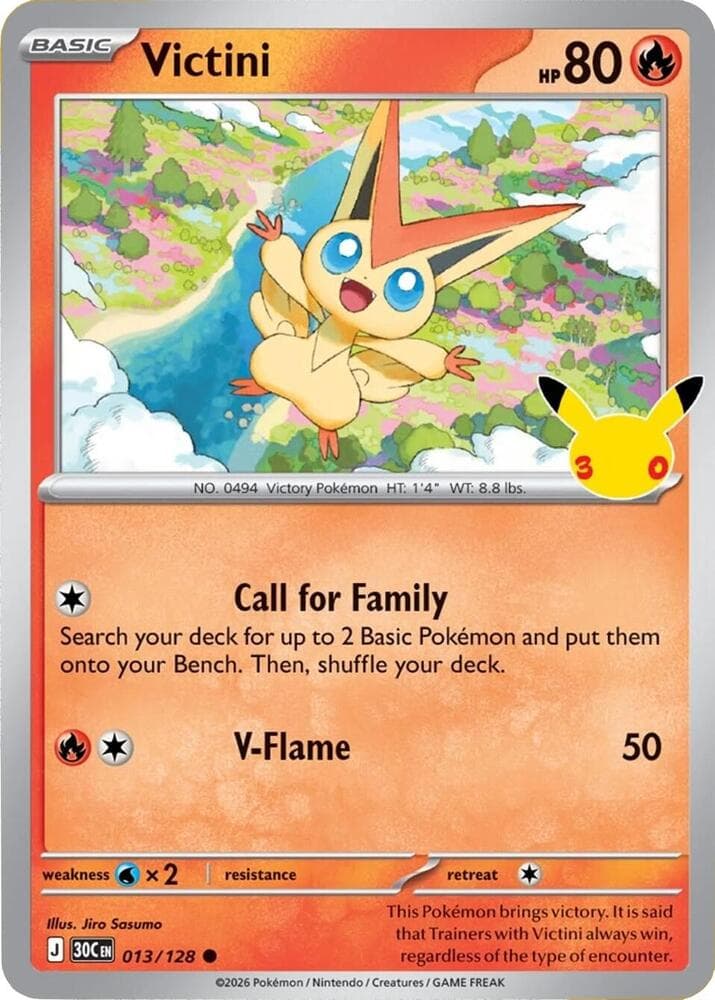
The victory Pokémon opening the revealed commons is exactly the kind of on-the-nose curation an anniversary set thrives on — Victini's whole identity is celebration. Remember that even this common is holofoil with the 30th logo: in this set there is no such thing as filler finish, only filler price.

View in catalog →

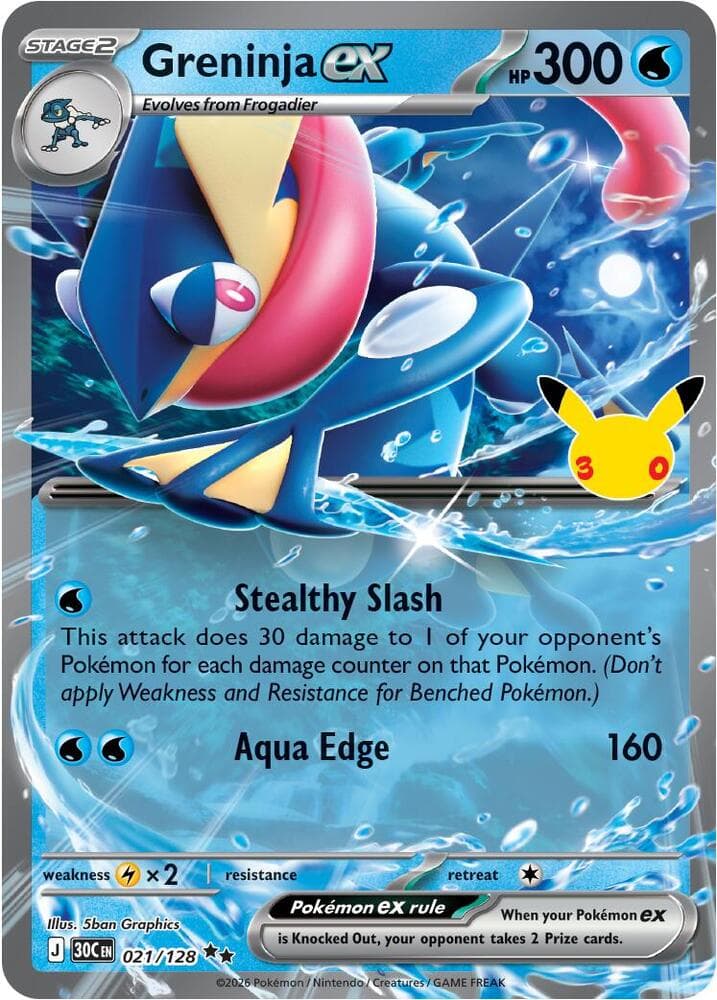
Greninja ex #021

Double Rare

Greninja remains one of the most popular Pokémon in every fan poll since Gen 6, and this Double Rare gives the set an early competitive-adjacent face. Greninja ex also fronts one of the two $21.99 ex Boxes and December's tin, making this one of the anniversary's most heavily merchandised Pokémon.

View in catalog →

Pikachu #036

The first of the three catalogued cards from the 30-Pikachu subset — thirty Pikachu, thirty illustrators, one guaranteed per pack. Individually none will be scarce; as a project, the full thirty is the set's signature binder page. Duplicates of these will be the set's natural trading currency.

View in catalog →

Pikachu #037

Second catalogued Pikachu of the thirty. The subset's promise is variety — each card carries a different illustrator's take and its own foil pattern, so 'which Pikachu did you pull?' becomes the set's pack-opening ritual. Expect completionists to be swapping these for months.

View in catalog →

Pikachu #047

Third of the revealed Pikachu subset cards. Ten numbers separate it from #037, hinting the thirty are spread across the checklist rather than clustered in one block — which means Pikachu duplicates across the whole numbering range, and easy trade matches for anyone listing their spares.

View in catalog →

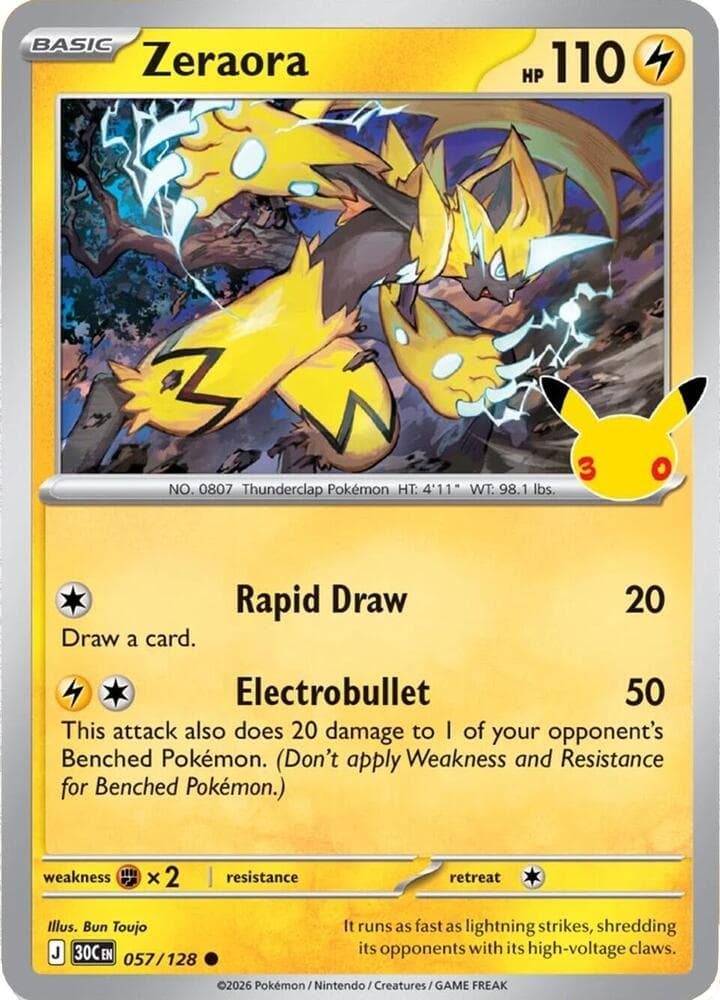
Zeraora #057

Common

Zeraora keeps the revealed commons in mythical territory — a thunderclap cat that headlined its own movie era and remains a favorite from the Sun & Moon years. Like Victini, it signals the commons tier is being curated for fan service, not just evolution-line plumbing.

View in catalog →

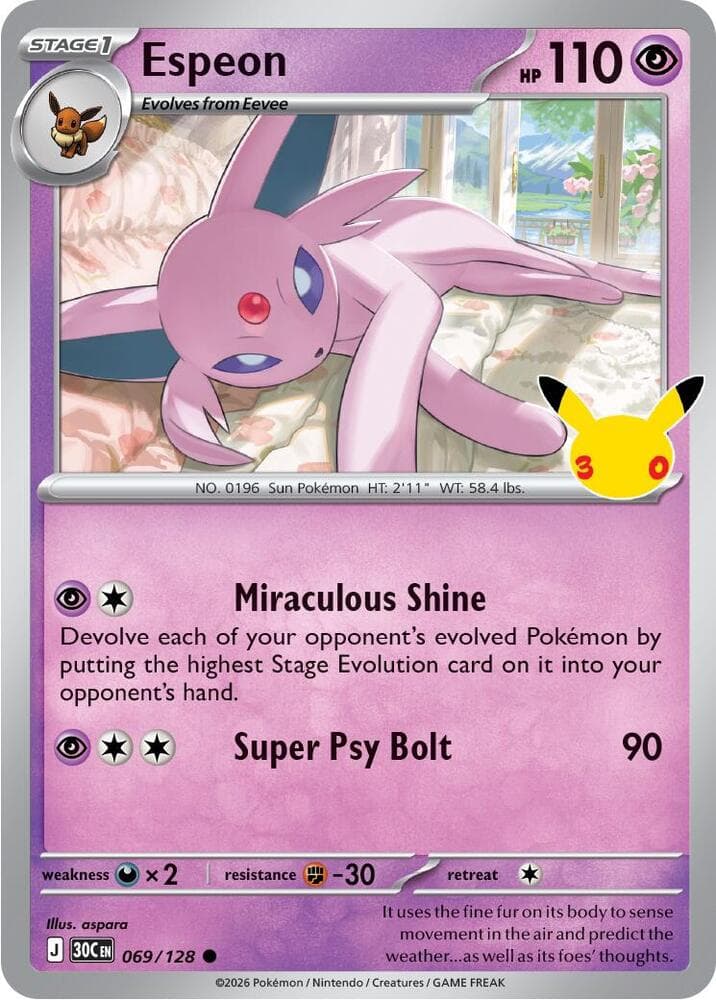
Espeon #069

Common

The daytime half of the set's day-and-night Eeveelution motif in its plain form. A holofoil Espeon common is the sort of card that would headline a promo product in an ordinary year; here it's a stepping stone to the ex versions and the Illustration Rares built on the same theme.

View in catalog →

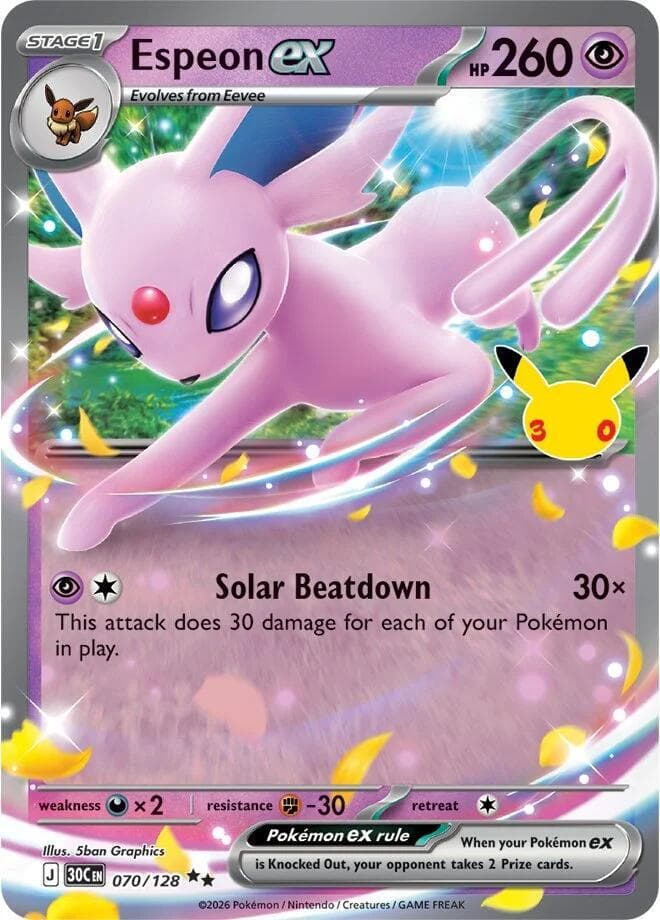
Espeon ex #070

Double Rare

Espeon ex anchors the 'Day' side of the anniversary's marketing — it fronts the Day Ultra-Premium Collection ($179.99, November 6) and one of the October 30 Battle Decks. Espeon's alternate-art pedigree in recent sets has been formidable, so its premium versions here will be watched closely.

View in catalog →

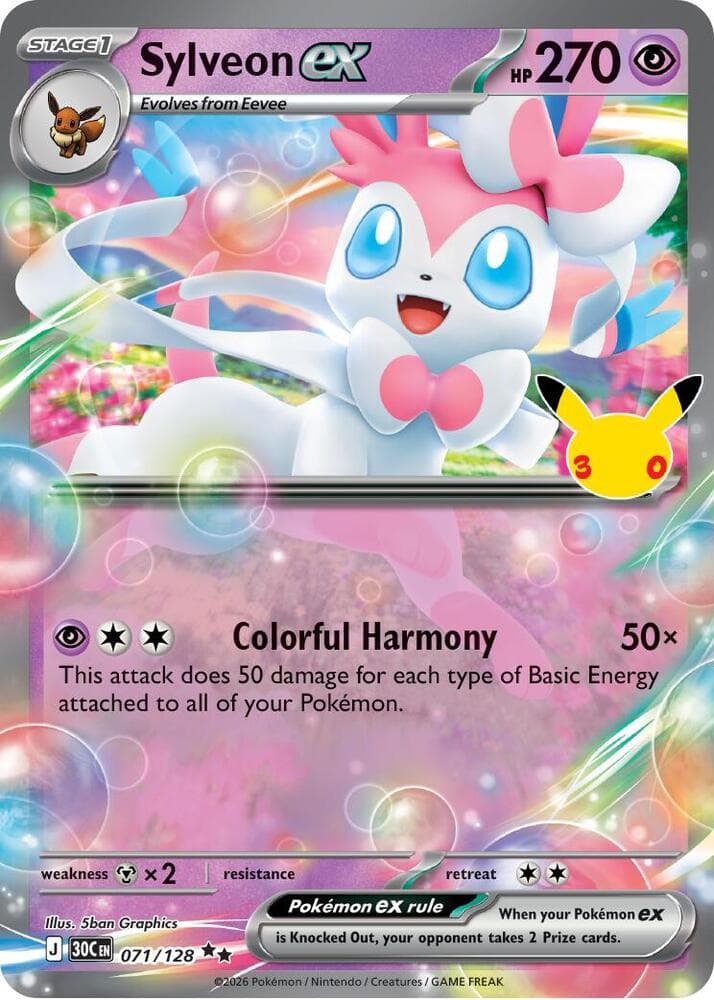
Sylveon ex #071

Double Rare

Sylveon ex completes the revealed ex trio and fronts one of the ex Boxes. Sylveon's collector market has run hot for years across every rarity tier it appears in; a new ex in an anniversary set with guaranteed spotlight treatment is an easy card to predict heavy demand for — which is precisely why patience beats preorder pricing here.

View in catalog →

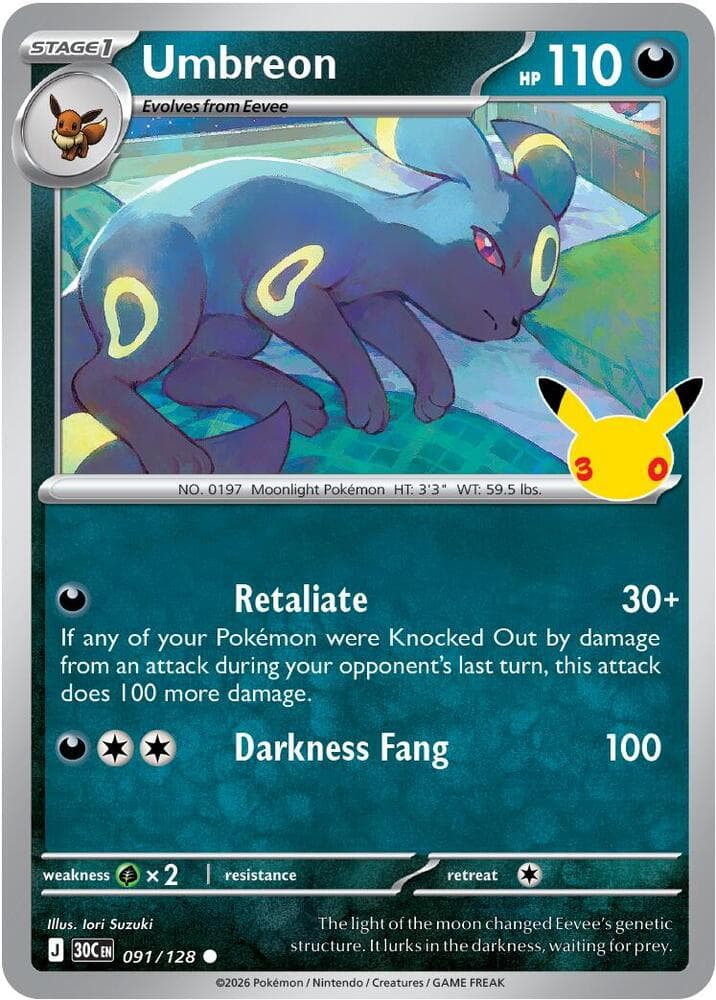
Umbreon #091

Common

The nighttime counterpart to Espeon #069. Umbreon is arguably the most collected Pokémon of the modern era after Pikachu and Charizard — any Umbreon in any set draws attention, and a 30th-logo holofoil common is the cheapest possible entry into that fandom.

View in catalog →

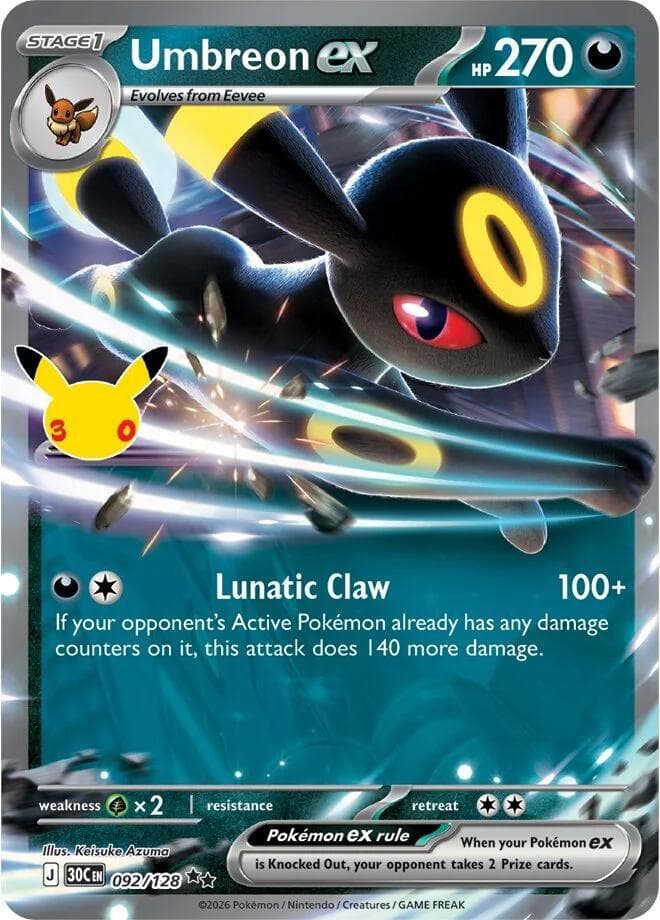
Umbreon ex #092

Double Rare

The revealed card with the heaviest expectations. Umbreon ex fronts the Night Ultra-Premium Collection and a Battle Deck, and every Umbreon chase card of the last five years has become a market event. Whatever premium versions of this card exist above #128 — none revealed yet — will likely define the set's top end alongside the Futuristic Rares.

View in catalog →

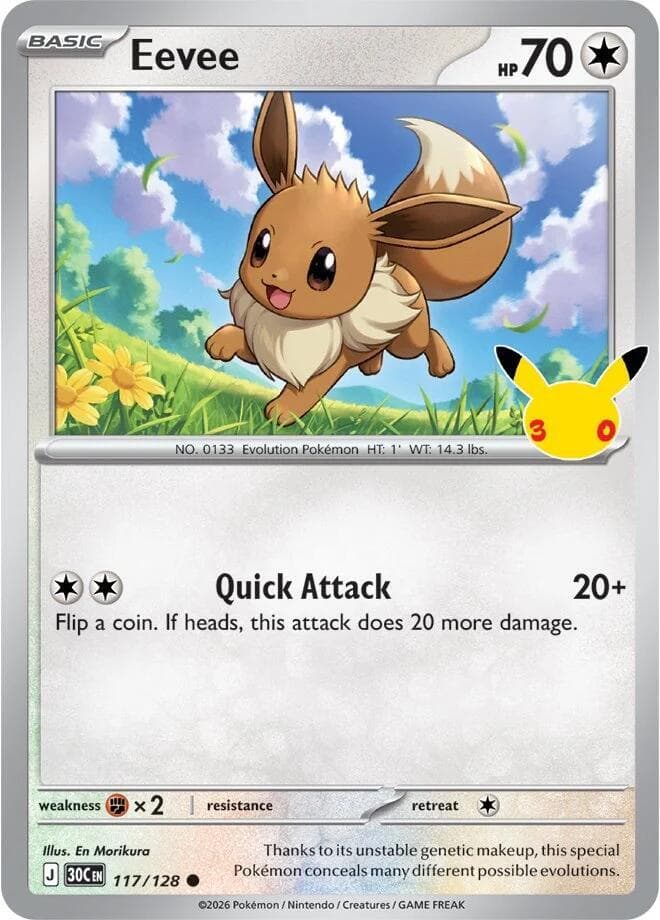
Eevee #117

Common

The first of two revealed Eevee — fitting for a set whose Japanese sibling products include an entire Eevee ex starter deck. Eevee is the anniversary's true mascot after Pikachu: the celebration's evolution theme starts here, and the Knock Out Collection's promo Eevee extends it outside the set.

View in catalog →

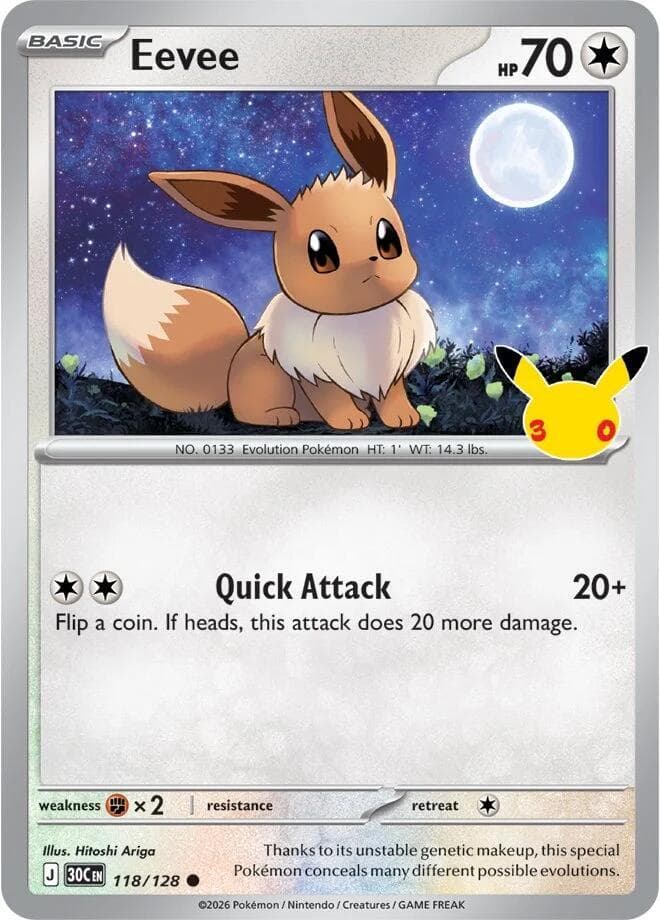
Eevee #118

Common

Second revealed Eevee, at consecutive numbering — suggesting a deliberate Eevee cluster in the checklist the way the set clusters its Eeveelutions. Two basic Eevee also means smooth trading supply for anyone assembling the full evolution family in anniversary form.

View in catalog →

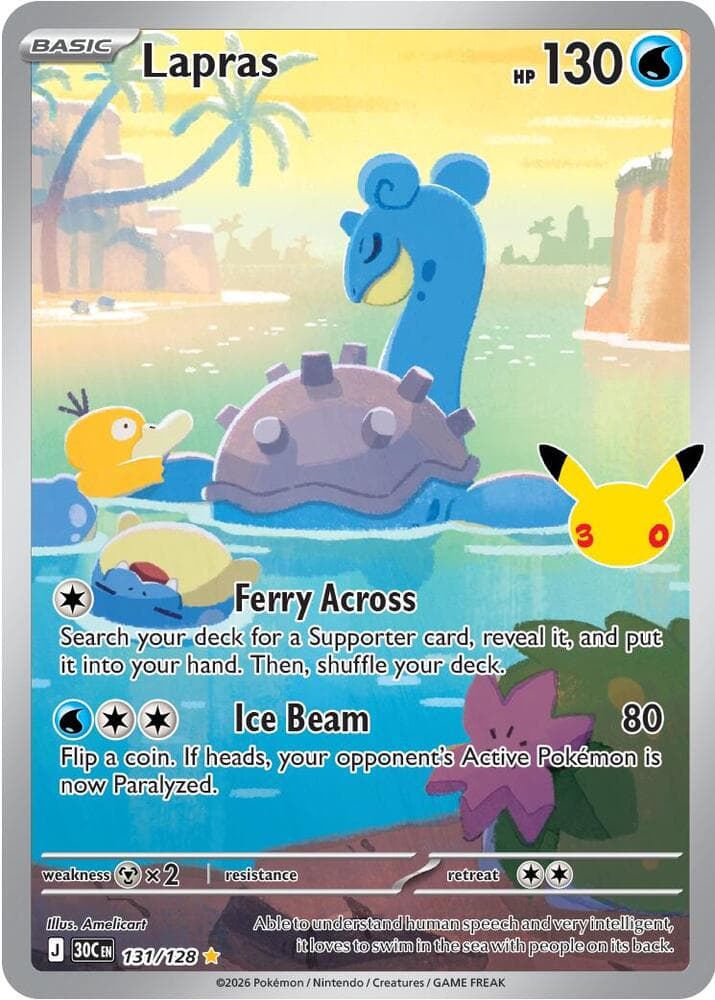
Lapras #131

Illustration Rare

The first of the four revealed Illustration Rares and a classic subject for one: Lapras has been a serene-scenery specialist since the 1990s. The set's IR series is built on a day-and-night motif, and Lapras's inclusion promises the contemplative end of that spectrum.

View in catalog →

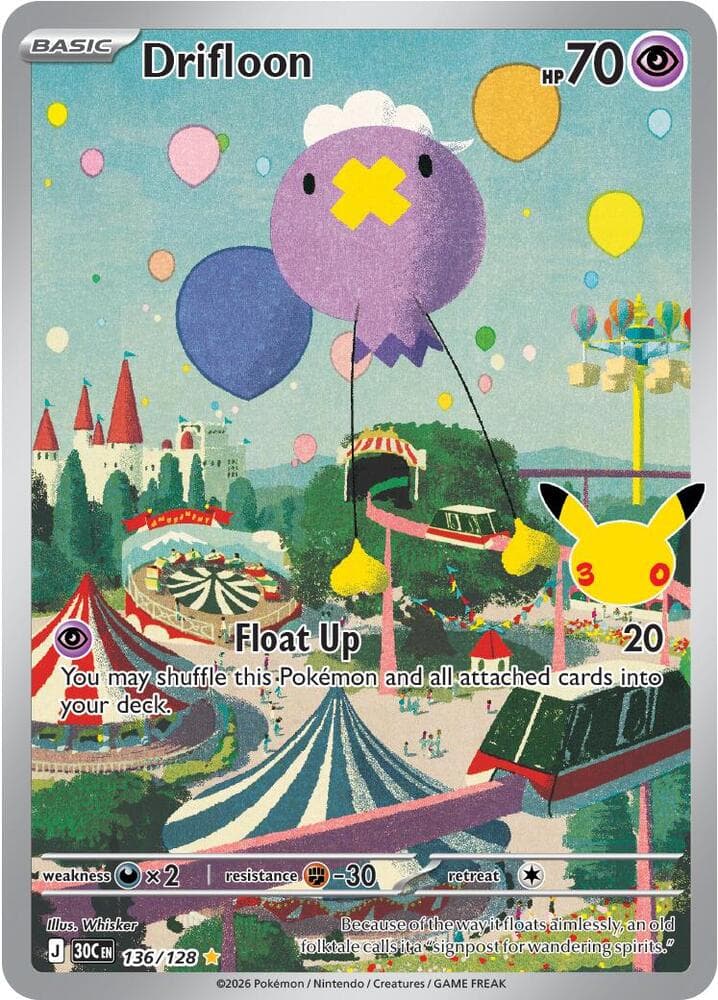
Drifloon #136

Illustration Rare

Drifloon continues the Illustration Rare tradition of elevating small, odd Pokémon into gallery pieces — the IR tier's best cards have historically come from exactly this register (think Paldea Evolved's Magikarp, reportedly among this very set's Classic Collection). A twilight balloon is a perfect day-to-night hinge subject.

View in catalog →

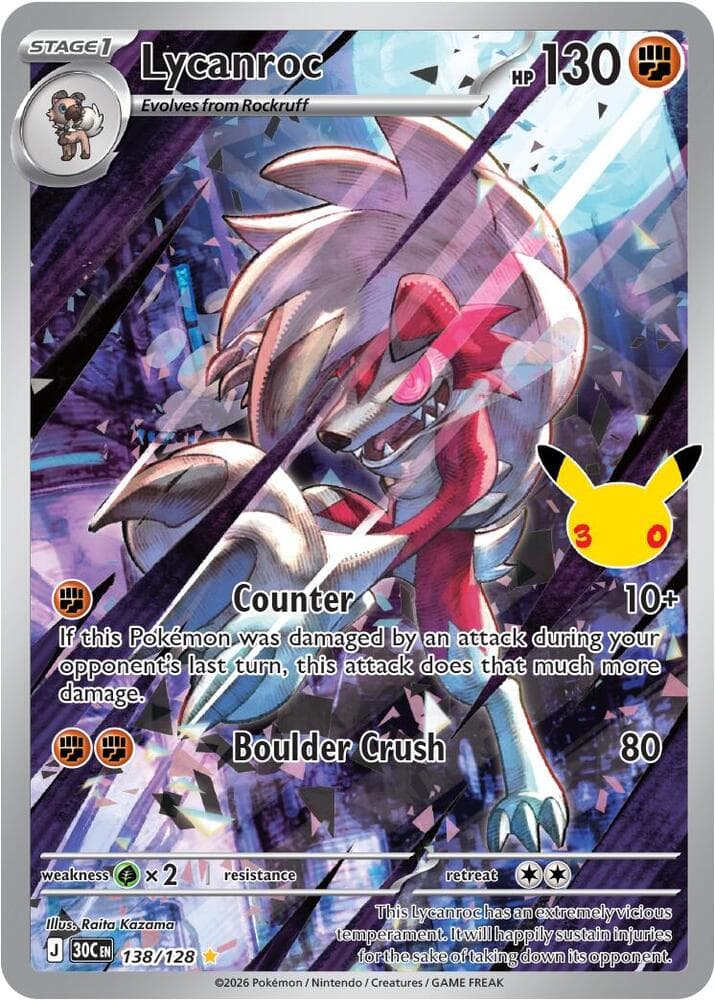
Lycanroc #138

Illustration Rare

Lycanroc's inclusion in the IR series is thematically sharp — a wolf whose forms literally depend on time of day, in a series about day and night. Midday, Midnight and Dusk forms make it the one Pokémon that embodies the whole motif in a single species.

View in catalog →

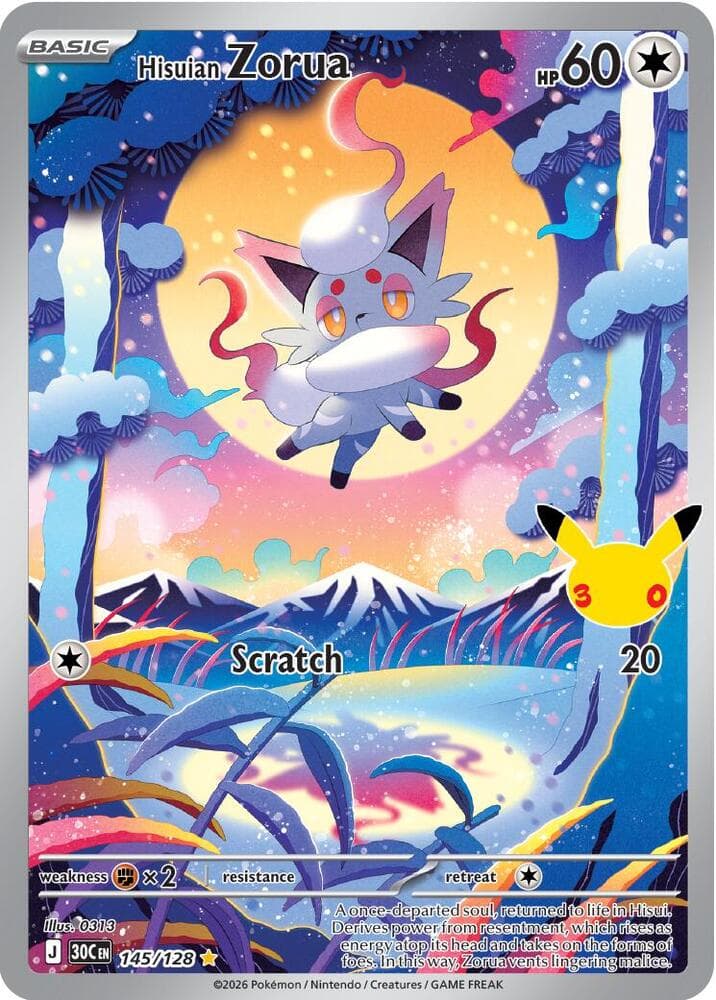
Hisuian Zorua #145

Illustration Rare

Hisuian Zorua brings the Legends: Arceus era into the anniversary's revealed cards — a 2022 addition standing alongside 1996 icons, which is the set's whole thesis in miniature. Its ghostly palette suggests the night end of the IR series.

View in catalog →

Mewtwo ex #157

Futuristic Rare

One of the set's two crown jewels and this guide's cover card. The first Futuristic Rare ever printed: Mewtwo ex by YOSHIROTTEN, a graphic artist invited from outside the game's regular illustrator pool, in a poster-like style the TCG has never used. Secret-numbered at #157 of 128, unpriced until real sales exist — the card everyone will be watching on September 16.

View in catalog →

Mew ex #158

Futuristic Rare

The second Futuristic Rare, and Mewtwo's eternal counterpart taking the set's final revealed number. Mew closed the original 151 in 1996; thirty years later it closes the anniversary checklist at #158. As with Mewtwo ex, ignore every 'price prediction' until actual copies trade — its live page will show real numbers when they exist.

View in catalog →

Follow the 30th Anniversary on Swaptio

Swaptio is a peer-to-peer exchange, not a shop — which makes it exactly the right tool for an anniversary: when the packs flood in after September 16, the fastest way to a complete Pikachu binder or a finished Eeveelution page is trading your duplicates for someone else's. All 19 revealed cards above already have live catalog pages, and the rest of the set will join them at launch, with prices that come from real activity rather than hype listings. Build your 30th Celebration wishlist now so you're matching with traders on day one, and list the anniversary cards you pull while demand is at its peak. Thirty years of cards are in circulation somewhere — the anniversary is the best excuse in a decade to move yours.

This hub will be updated as the anniversary unfolds — new reveals, the remaining checklist, pull-rate data once boxes are opened, and the fall product waves. For deeper dives, the companion guides: the 30th Celebration set guide (card-by-card tracker), Storm Emeralda / M6, Japanese vs. English cards, rarity symbols and special art rarities.

Frequently asked questions

When does the Pokémon TCG 30th anniversary set release?

ME: 30th Celebration launches worldwide on September 16, 2026 — the first simultaneous global release in the game's history, covering all print languages including Japanese and Simplified Chinese on the same day. Further anniversary product waves follow on October 2, October 30, November 6 and December 4, 2026.

How many cards are in 30th Celebration?

The printed checklist runs to 128 cards, with secret rares numbered above that — the revealed Futuristic Rare Mewtwo ex and Mew ex sit at #157 and #158, and Bulbapedia counts the English set at 160+ cards in total. Every card in the set is holofoil and carries the 30th anniversary logo.

What is a Futuristic Rare?

A brand-new rarity tier debuting in this set, featuring artwork by Japanese graphic artist YOSHIROTTEN in a vivid, poster-like style new to the TCG. Two are revealed: Mewtwo ex (#157) and Mew ex (#158). Pull rates haven't been officially published, but their secret numbering places them at the rare end of the set.

Will classic cards like Base Set Charizard be reprinted?

Yes. The set includes a Classic Collection of 30 reprints from across the game's 30-year history, each with original artwork, special foil and a '30' Pikachu-silhouette stamp. Officially confirmed so far: Base Set Charizard and Pikachu & Zekrom-GX. A reported full list of all 30, captured from the Japanese official site by fan press, includes Crystal Lugia, Shining Celebi, Gengar Prime, N and Arceus VSTAR — but only the first two are individually confirmed.

Is there really a Pikachu in every pack?

Yes — officially confirmed. Every 30th Celebration booster pack contains one of 30 different Pikachu cards, each illustrated by a different artist with its own foil pattern. Individually they won't be scarce; completing all 30 is the set's built-in collecting project, and trading duplicates is the practical way to finish it.

What's different about the Japanese version of the anniversary?

The set itself releases the same day in Japan (as MEGA Expansion Pack 30th CELEBRATION) in 20-pack boxes at ¥7,200, with 6-card ¥360 packs, plus exclusive premium packaging like the ¥27,500 Futuristic Box. Japan also had its own July 31, 2026 double release — the M6 Storm Emeralda expansion and three Japanese-only MEGA Starter Set ex decks (Eevee ex, Zoroark ex, Meowscarada ex, ¥1,800 each) — whose English counterpart, Delta Reign, arrives November 6, 2026.

How much do the anniversary products cost?

Official MSRPs run from $5.49 (Mini Portfolio) and $9.99 (Mini Tins, Knock Out Collection, 2-Pack Blister) through $14.99 (Poster and Tech Sticker Collections), $19.99 (Battle Decks), $21.99 (ex Boxes, December tins), $26.94 (Booster Bundle), $29.99 (Figure Collections), $31.99 (Binder Collection), $39.99 (Ditto Premium Collection) and $49.99 (Elite Trainer Box), up to $179.99 for the Day and Night Ultra-Premium Collections. Street prices during launch hype will vary — the 2021 precedent says patience returns most products to MSRP.

Are 30th Celebration cards worth anything yet?

No — and treat any current 'price guide' skeptically. The set releases September 16, 2026, and until real copies trade, no card has a market price; that's why every card in this guide shows none. Once sales begin, live prices appear on each card's Swaptio page automatically. The 2021 Celebrations precedent suggests most singles will be inexpensive, with value concentrating in top rarities, gem-mint grades and sealed product bought at retail.